

When thinking becomes an obstacle
When thinking becomes an obstacle. Not Every Thought Needs More Thinking
You have a question.
So you think about it.
Then, because it is 2026, you ask AI.
It gives you six angles, three frameworks, a table, twelve follow-up questions and—if you are not careful—a suggested action plan for the rest of your natural life.
Twenty minutes later, you know more.
But somehow you are not much wiser.
We are living in a strange age.
For almost any question, we can now ask for more.
More analysis.
More angles.
More context.
More options.
More prompts.
More bullet points.
And sometimes, after all that, we understand absolutely nothing better.
We are just tired.
Maybe the useful question is not always:
“How can I think more about this?”
Maybe it is:
“What kind of thinking would actually help here?”
There are at least five useful answers.
1. Deepen
Sometimes a thought is interesting but still a little thin.
You have the feeling there is something there, but you have not quite reached it yet.
So you stay with the thought a little longer.
Not twenty-seven tabs longer.
Just long enough to ask:
“What is really going on here?”
“What am I missing?”
“Why does this matter?”
Deepening means going further into the same idea rather than immediately looking for another one.
2. Challenge
Sometimes we become very fond of our own explanation.
This is usually the perfect moment to become mildly suspicious of it.
Ask:
“What if I am wrong?”
“What would someone who disagrees with me notice?”
“What evidence would change my mind?”
Not in a dramatic, existential way.
You are not trying to destroy the thought.
You are simply opening a window and letting some fresh air into the room.
3. Connect
Sometimes the useful idea comes from somewhere else entirely.
A conversation.
A memory.
Something you read years ago.
A problem from a completely different part of your life.
Our minds are surprisingly good at this.
They are less like filing cabinets and more like slightly chaotic dinner parties.
Connecting means asking:
“What does this remind me of?”
Sometimes two ordinary ideas become interesting only when they meet each other.
4. Reframe
Sometimes the problem is not the problem.
The frame is.
We may be asking:
“How do I become more productive?”
when the better question is:
“Why am I trying to fit twelve hours of life into six?”
Or:
“How do I make this decision?”
when the more useful question is:
“What am I actually afraid of losing?”
Reframing does not give you another answer.
It gives you a better question.
And a better question can sometimes do more than another hundred answers.
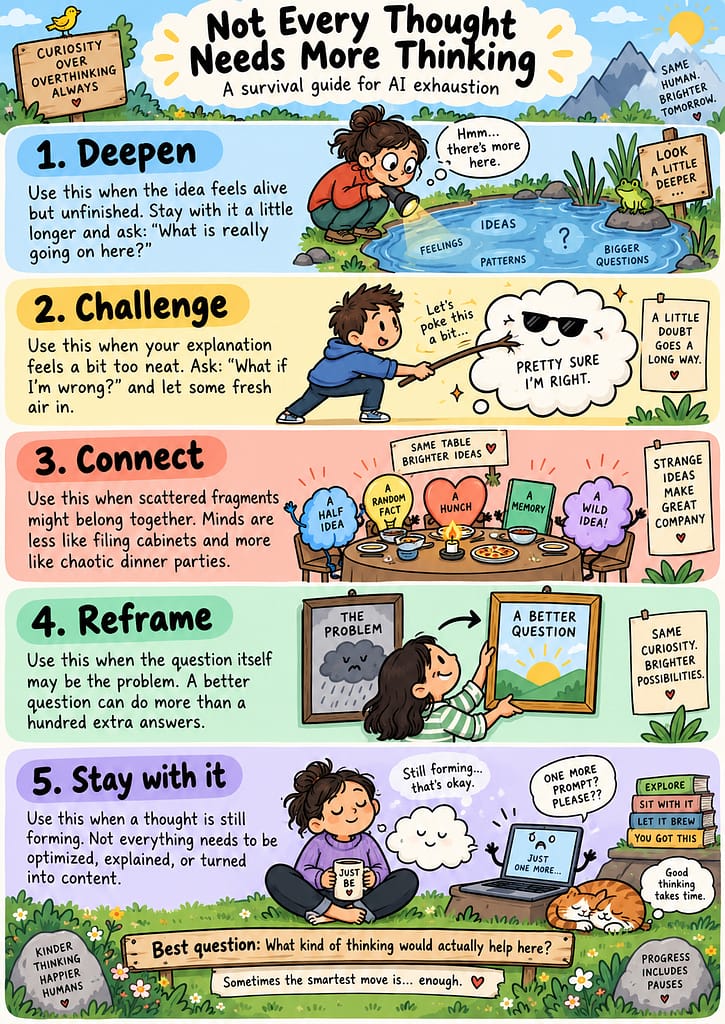
5. Stop
This one may be the hardest.
Sometimes a thought does not need to be deepened, challenged, connected, optimized, summarized or turned into a framework.
Sometimes it can just sit there.
You do not need to solve every uncertainty.
You do not need to reach a conclusion today.
You do not need to turn every interesting thought into content.
Especially now.
With AI available everywhere, the temptation is to keep going simply because we can.
One more prompt.
One more perspective.
One more “comprehensive breakdown.”
But intelligence is not always about adding more.
Sometimes the useful move is to go deeper.
Sometimes it is to challenge.
Sometimes to connect.
Sometimes to change the question.
And sometimes there is no useful move at all.
Your brain may even send you a helpful signal.
It is called:
“Enough.”
Worth listening to.
Thank you for reading, shares and comments!
Related Posts

The mind after the ladder

Thinking, Fast and Curious? AI Climbs the Ladder

Benjamin Bloom’s 6 ways of thinking & modern takes

The Fine Line Between Innovation & Ethical Responsibility

Philosophical Insights Into The Ethics Of Artificial Intelligence

Beginner’s Guide To 3D Printing Prototypes For Inventors

How To Create A Business Plan For Your Invention

Turn Your Garage Into An Innovation Lab
The Fine Line Between Innovation & Ethical Responsibility
