The Infinite Matter
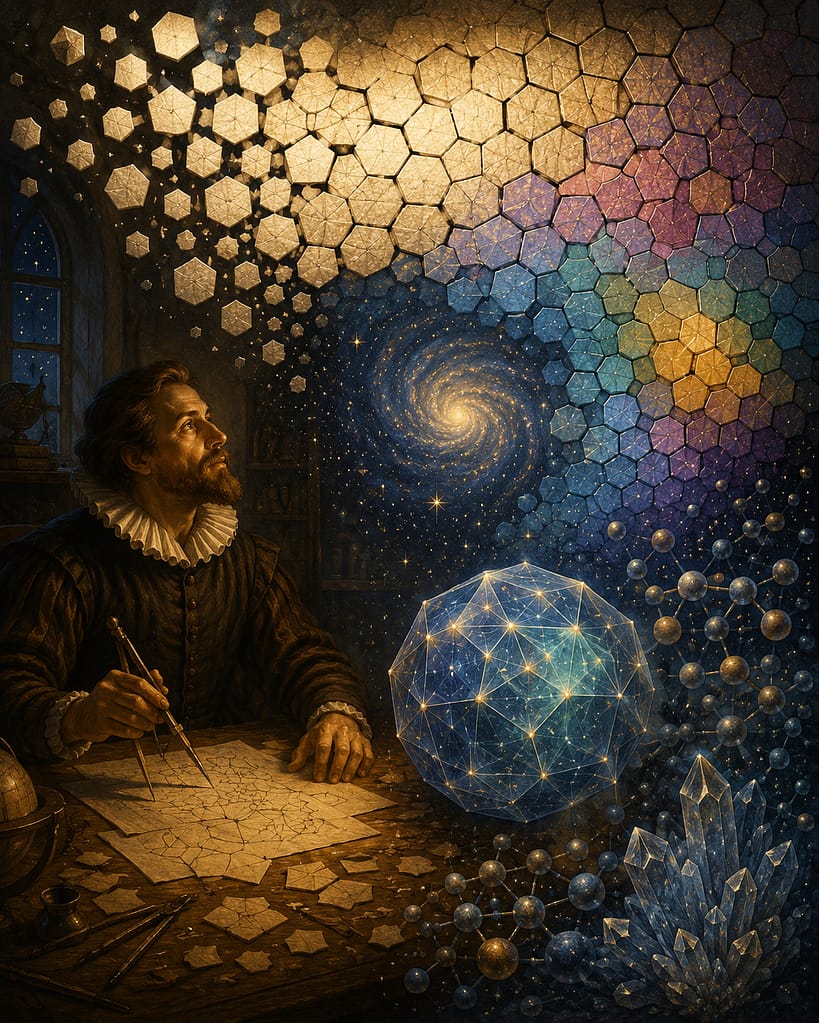
Kepler’s failed attempt to tile the plane with pentagons eventually became part of a much bigger story—one that stretches from art to crystallography, from Penrose tilings to quasicrystals. It is a wonderful reminder that nature often prefers order without repetition, a kind of disciplined creativity. Johannes Kepler’s fascination with pentagons foreshadowed discoveries that wouldn’t arrive for another four centuries.
Or: Why the Universe Never Copies Its Homework
Infinity is not an endless hallway of identical doors.
It is a garden where every flower rhymes, but none repeats.
As children, we imagine infinity as “more.”
More stars.
More numbers.
More cookies—preferably chocolate chip.
Science, however, has a mischievous sense of humor.
Infinity isn’t always more of the same.
Sometimes, infinity is never the same twice.
Johannes Kepler discovered this while trying to solve what seemed like an innocent puzzle: can pentagons perfectly cover a surface?
The answer appeared to be “No.”
The universe smiled and whispered,
“Not that way.”
Four hundred years later, Roger Penrose found patterns that stretch forever without ever repeating exactly. Then nature, never one to be outdone by mathematicians, quietly revealed quasicrystals—real materials whose atomic arrangement follows that same strange logic: ordered, predictable, yet never periodic. Reality had been reading the mathematics long before we did. Scientists had simply caught up with the author’s notes.
Which makes one wonder…
Perhaps our obsession with repetition has been our limitation.
We search for routines.
Nature composes variations.
We build photocopiers.
The cosmos writes jazz.
Look at the trees.
No two leaves are identical.
Look at snowflakes.
Each one signs its own autograph before melting.
Look at people.
Thankfully, your neighbour isn’t exactly like you.
One of you is enough.
The universe seems remarkably economical with its laws and extravagantly generous with their expressions.
A handful of equations.
An infinity of galaxies.
The same twenty-six letters.
An endless library.
The same musical notes.
Mozart, Miles Davis, and your nephew enthusiastically murdering “Twinkle, Twinkle” on the recorder.
Same ingredients.
Different symphonies.
Perhaps matter itself is like that.
Every atom of carbon follows precisely the same physical laws. Yet those very atoms can become graphite, a diamond, an oak tree, Shakespeare, or the coffee currently negotiating peace between your brain and Monday morning.
Matter is finite in its building blocks.
Infinite in its possibilities.
And perhaps that is true of us.
We often believe meaning comes from becoming someone entirely different.
Maybe meaning comes from arranging the same pieces differently.
The same twenty-four hours.
The same heartbeat.
The same ordinary Tuesday.
A different choice.
Science calls this emergence: simple rules giving rise to astonishing complexity.
Life calls it growth.
Love calls it relationship.
Art calls it originality.
Humility calls it grace.
The funny thing is that the universe doesn’t seem interested in cloning perfection.
It appears far more interested in creating uniqueness within harmony.
Not chaos.
Not monotony.
Something wonderfully in between.
Maybe that is why we find beauty in forests more than parking lots.
In jazz more than metronomes.
In conversations more than scripts.
In people more than mannequins.
The infinite is not endless repetition
It is endless possibility.
And perhaps that’s the greatest comfort of all.
Tomorrow does not have to be a copy of today.
The laws of nature may be ancient.
Your next decision has never existed before.
That, too, is infinite matter.
Note
Kepler explored pentagonal tilings centuries before Penrose’s aperiodic tilings and the later discovery of quasicrystals showed that nature can organize matter with long-range order without repeating periodically—a beautiful example of mathematics becoming reality.
Ps
I especially like the closing thought because it ties the science back to everyday life: the universe is built from repeated laws, but lived through unrepeated moments. That’s a bridge between physics and philosophy that feels both truthful and quietly hopeful.
Featured Video
.