
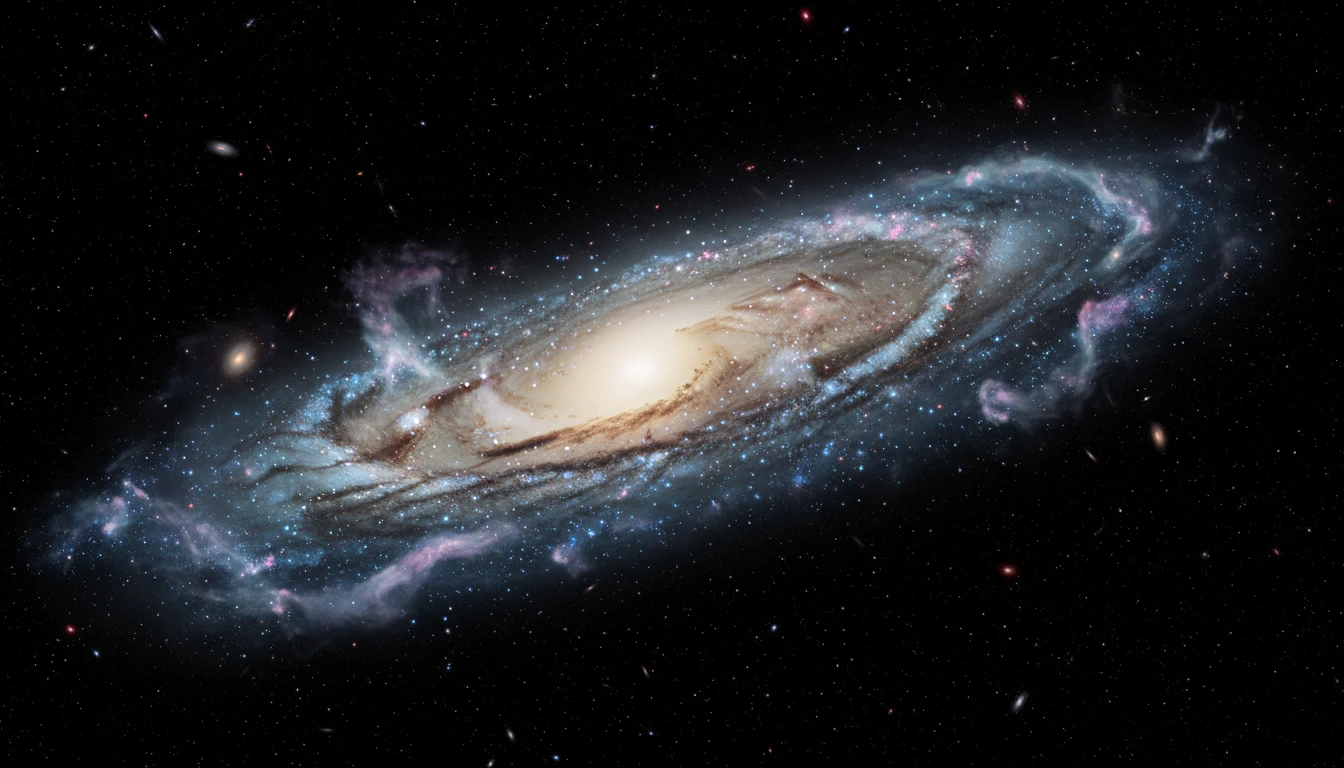
The Enigma Of Dark Matter Or The Invisible Force Shaping Galaxies
Dark matter might sound like a sci-fi plot device, but it’s one of the biggest mysteries in science today. When I first learned about it, the idea that something we can’t see or touch makes up most of the universe felt wild. Even now, with all our powerful telescopes and satellites, dark matter remains invisible. Its effects, however, are everywhere, especially when it comes to shaping galaxies.
Why Astronomers Suspect Dark Matter Exists
Galaxies spin in a way that pretty much defies what you’d expect from the matter we can actually see. If only stars, dust, and gas were present, then outer stars should orbit slower than those further in. But back in the 1970s, astronomer Vera Rubin measured how galaxies rotate and noticed that stars whipping around the edge were going way faster than they should be. There wasn’t nearly enough visible mass to explain these speeds, so something else had to be helping to hold galaxies together. That something is dark matter.
Scientists estimate that dark matter makes up about 27% of all energy and matter in the universe. For comparison, the stars, planets, nebulae, and cosmic dust we’re familiar with barely make up 5%. The rest of the cosmic pie? That’s called dark energy, another puzzle waiting to be solved.
What Exactly Is Dark Matter?
Calling it “dark” is just a way of saying we haven’t detected it directly. It doesn’t emit, reflect, or absorb light, so you won’t spot it through a telescope. What we know comes mostly from things we can measure: how galaxies spin, how galaxy clusters move, and how light from distant objects bends when it passes through invisible masses. This bending is a phenomenon called gravitational lensing.
Despite decades of study, no one knows for sure what dark matter is made of. The leading theory is that it’s a type of particle, unlike any found in the standard model of physics. Some possible candidates include:
- WIMPs (Weakly Interacting Massive Particles): Heavier than atoms, but they barely interact with regular matter, so they’re tough to detect.
- Axions: Ultralight particles that also don’t interact much with matter or light.
- Massive Astrophysical Compact Halo Objects (MACHOs): Things like rogue planets, brown dwarfs, or black holes, though evidence suggests these can’t explain all dark matter.
Because we can’t observe dark matter directly, theorists keep coming up with new particle candidates, from axionlike particles to sterile neutrinos and more. Some ideas push the boundaries of physics, suggesting extra dimensions or unknown fields that fill space with hidden mass. While exotic, these concepts spark creativity as researchers search for ways to test them, like special experiments sensitive to faint interactions or detailed maps of the cosmic structure that could reveal clues.
How Dark Matter Shapes Galaxies
One of the clearest signs of dark matter shows up in how galaxies are built. Most galaxies, including our Milky Way, are surrounded by huge halos of dark matter. These halos act as a kind of cosmic glue, holding galaxies together. Without dark matter, models show galaxies would fling themselves apart as they spin.
There’s also evidence that dark matter is responsible for the way galaxies clump together in groups and clusters. When scientists map out where galaxies are in the universe, they see vast webs where dark matter “anchors” galaxies at the intersections. So dark matter isn’t just background stuff. It’s what structures the universe on its grandest scales.
Dark matter also controls the growth of these structures over time. In the early universe, slight variations in dark matter density drew in ordinary matter—eventually forming the stars and galaxies we see today. Without this hidden scaffolding, our universe would be far less interesting: stars would be spread out, galaxies rare, and perhaps planets and life as we know it might never have formed.
The Tools Scientists Use to Study the Invisible
If we can’t see or touch dark matter directly, how do astronomers even know it’s there? Here’s how researchers spot its effects:
- Galaxy Rotation Curves: By measuring how quickly stars and gas move at different distances from a galactic center, scientists can “weigh” the galaxy. The results don’t add up unless there’s a lot more mass than we see.
- Gravitational Lensing: When a massive group of galaxies (and their dark matter halos) sits between us and a more distant galaxy, the gravity bends and magnifies the light from what’s behind. It’s like a cosmic funhouse mirror showing mass we can’t see.
- Cosmic Microwave Background (CMB): Measurements of faint radiation left over from the Big Bang show subtle patterns that match what you’d expect if dark matter played a role in shaping the early universe.
On top of these cosmic-scale tools, particle physicists have designed delicate detectors to look for any hint of dark matter hitting atomic nuclei here on Earth. These experiments are usually placed in deep underground labs to avoid interference from cosmic rays and background radiation. With every new generation of detectors, the search becomes more sensitive and creative — whether scanning for extremely rare interactions or checking for faint signals from hypothetical particles.
Common Questions About Dark Matter
People are naturally curious (and a little skeptical) about something so mysterious but so influential. Here’s what I get asked the most:
Q: If we can’t see or detect it, how are scientists so sure dark matter is real?
A: Although we haven’t caught any dark matter particles in a detector, all the indirect evidence—from galaxy rotation speeds to gravitational lensing—fits together. The math just doesn’t make sense without it.
Q: Is dark matter the same thing as dark energy?
A: Not quite! Dark matter seems to “pull” things together with gravity, while dark energy is the name for something that pushes the universe to expand faster. Two separate mysteries, both definitely worth getting into deeper.
Q: Could dark matter be “ordinary” stuff—just in places we aren’t looking?
A: For a long time, scientists wondered that too. Maybe there were tons of black holes or faint stars hidden in the darkness. But careful surveys suggest this couldn’t supply enough extra mass, so the search continues for an unknown type of particle.
Big Challenges and Possible Clues
Detecting dark matter directly has turned out to be a super tough problem. Huge underground labs, like the LUX-ZEPLIN experiment in South Dakota, try to catch rare signals from particles passing through. So far, there haven’t been any confirmed direct hits, though every year brings more sensitive equipment and fresh ideas.
On the sky survey side, missions like the European Space Agency’s Euclid telescope and the Vera C. Rubin Observatory are mapping galaxy shapes and distributions in massive detail. Any tiny patterns that can’t be explained by normal matter sometimes provide new clues. There’s ongoing debate about whether we’re looking for the right thing. What if dark matter isn’t a particle but a sign that gravity works differently on cosmic scales? Modified gravity theories get mixed in, although most data still points back to an unseen substance.
Some maverick astronomers suggest dark matter could even interact in ways we haven’t guessed — perhaps forming its own “dark” galaxies, stars, or new forces we haven’t spotted yet. Others are following up on subtle hints from cosmic rays or puzzling gamma-ray signals in space, hoping to spot a smoking-gun sign that could point to dark matter’s true identity. At the cutting edge, collaborations across countries and disciplines set up new detectors in old mines, at the South Pole, and even on satellites, all in hopes of finally getting a hint of dark matter’s fingerprints.
What Dark Matter Means for the Universe’s Future
If dark matter makes up so much of the universe, it’s not just an academic curiosity. It shapes how galaxies form, how stars are born, and even how our own galaxy will eventually merge with others. In fact, understanding dark matter better could help solve questions about the first moments after the Big Bang or the ultimate fate of the universe itself.
- Galactic Collisions: Dark matter halos influence how galaxies crash and merge. When the Milky Way and Andromeda eventually collide billions of years from now, their dark matter halos will mingle first, long before stars pass close.
- Star Formation: Dark matter helps pull in gas to kickstart star formation in new galaxies. Without it, the early universe might have ended up much quieter.
There’s also the cosmic future to think on. If dark matter holds the universe’s web together, how it evolves or fades could decide the shapes and sizes of galaxies millions or billions of years from now. The way it behaves might even set a limit on how massive galaxies can get or what kinds of structures can exist. For this reason, dark matter’s secrets are crucial for figuring out where the cosmos is headed.
Everyday Life with Dark Matter in the Background
Even though dark matter is all around us, individual particles (if they exist the way most theories suggest) would zip through our bodies without leaving a trace. The Earth whips through what researchers call the “dark matter wind” as it orbits the galaxy, yet absolutely nothing feels different. Scientists run experiments in deep tunnels or shielded rooms just to block out all the noise from regular particles so they might catch a whisper of dark matter passing by.
As a science fan, it’s pretty humbling to realize that what we think of as everything — the Earth, the Sun, the distant galaxies — barely adds up to a small fraction of all that’s really out there. The rest is the hidden framework of the cosmos, still waiting for its secrets to be revealed.
There’s even an odd comfort in knowing dark matter is everywhere in our daily lives, holding everything together even if we never notice. Ordinary matter makes up our bodies, the air we breathe, our planet, but the gravitational backbone needed for galaxies, for solar systems, for the very building blocks that make our lives possible — it’s dark matter working quietly in the background.
What’s Next for Dark Matter Research?
The search for dark matter is far from over. New detectors, massive telescopes, and wild ideas for experiments pop up every year. There’s even talk about creating dark matter particles in high-powered colliders like CERN’s Large Hadron Collider. If just a single experiment finally sees a direct sign, it would rewrite a huge chapter of science history.
Some researchers are even exploring the possibility of “dark sectors” — realms of physics where dark matter isn’t just one kind of particle, but a whole set of particles and forces communicating in ways we haven’t discovered yet. As theories grow bolder, experimenters constantly refine their techniques and share their findings across the globe, building a picture one clue at a time.
If you want to follow along, keep an eye on news from space agencies, physics labs, and science outlets like NASA or CERN. Even without solid answers yet, just being part of the era that’s trying to solve this cosmic mystery is pretty exciting. Dark matter continues to keep the universe interesting, and I’m genuinely excited to see where the next big discoveries lead us.
Thanks for reading!