
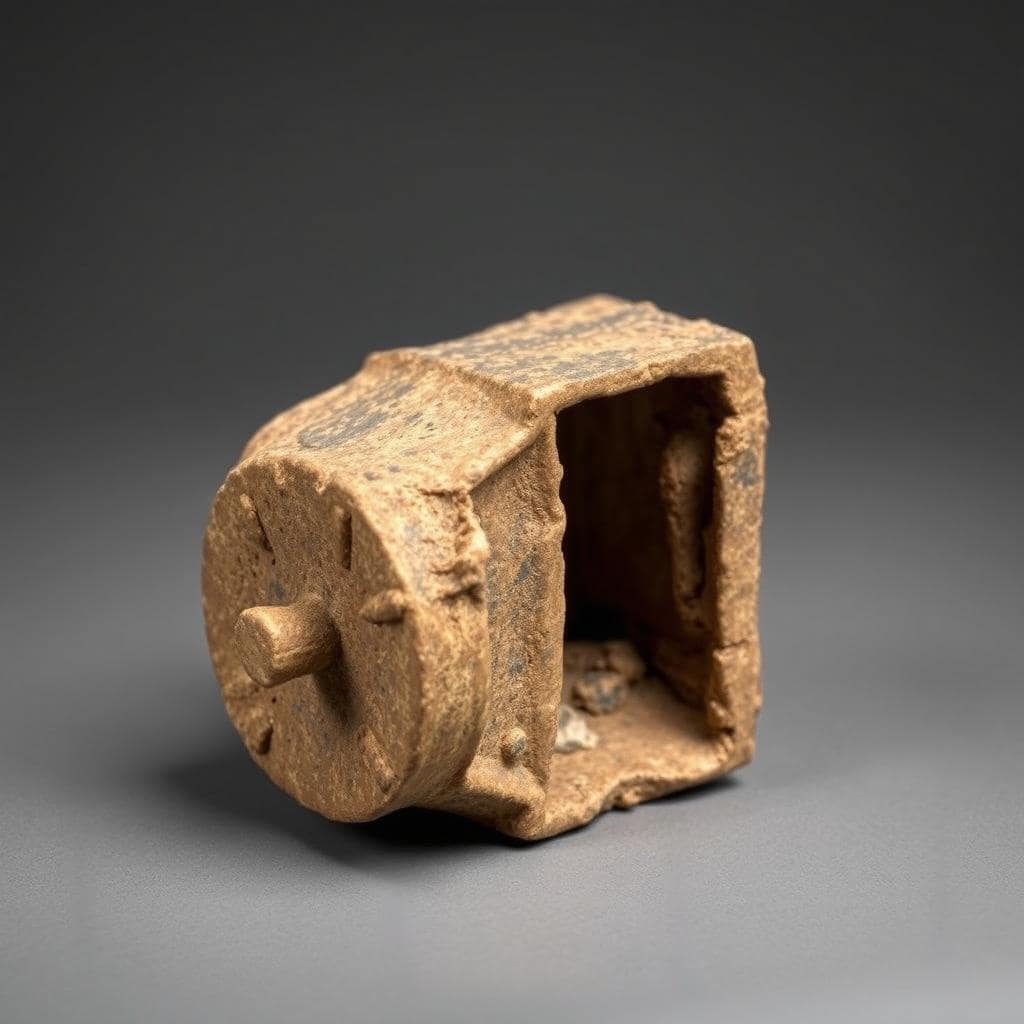
Antikythera Mechanism
The Antikythera Mechanism – An Ancient Greek Marvel of Astronomy and Engineering
The Antikythera Mechanism is one of the most astonishing archaeological discoveries of the modern era. Found in a shipwreck off the Greek island of Antikythera in 1901, this intricate device has revolutionized our understanding of ancient Greek technology, astronomy, and their conceptualization of the cosmos. Scholars and engineers have worked tirelessly for over a century to decipher its function, leading to remarkable discoveries that suggest it was an analog computer, far ahead of its time.
Discovery and Initial Investigations
In 1901, Greek sponge divers stumbled upon an ancient shipwreck near Antikythera, which contained numerous artifacts, including bronze statues, pottery, coins, and an enigmatic corroded mass of gears and inscriptions. Initially overlooked, the mechanism was later recognized as an intricate clockwork-like device with a series of interlocking gears. It was housed in a wooden box and appeared to have dials and inscriptions, suggesting a sophisticated purpose.
Over the following decades, researchers analyzed the mechanism using X-ray imaging and other advanced techniques, revealing a complex assembly of at least 37 gears and a system of dials that allowed for precise astronomical calculations.
Structure and Functionality
The Antikythera Mechanism consists of several components that work together to track celestial movements. The front dial displays the Greek zodiac and an Egyptian calendar, aligning to show the position of the Sun and Moon. Behind the front panel, a series of gears simulate the motion of celestial bodies, demonstrating an understanding of lunar and solar cycles.
One of the most remarkable aspects of the mechanism is its ability to predict eclipses. A back panel, known as the Saros dial, tracks the 223-month cycle used by ancient astronomers to forecast lunar and solar eclipses. Other dials align with the Metonic cycle, a 19-year period crucial for maintaining the accuracy of the Greek calendar in relation to the lunar phases.
Recent Discoveries and Technological Insights
In recent years, scientists have used 3D imaging and high-resolution scans to reconstruct missing parts of the mechanism. One of the most significant findings is that the device likely contained at least 354 holes on its calendar ring, indicating it was designed to track the lunar year rather than a solar calendar.
Studies have also revealed inscriptions on the mechanism, which describe planetary motions, suggesting that it may have been used to model the known planets of the time. This has led to the hypothesis that it was a teaching tool or a device for calculating celestial events with remarkable accuracy.
The Mechanism and Greek Science of the Cosmos
The Antikythera Mechanism is a testament to the advanced scientific knowledge of the ancient Greeks. It aligns with the works of philosophers and mathematicians such as Hipparchus and Archimedes, who developed theories about planetary motion and celestial mechanics. Some scholars believe that Hipparchus, one of the greatest astronomers of antiquity, may have influenced its design due to the presence of his lunar theories within the mechanism’s gearing system.
The Greeks viewed the cosmos as a harmonious and mathematically precise system, and the mechanism embodies this worldview. It not only tracked celestial events but also demonstrated an understanding of the relationships between different astronomical cycles, blending observation with mechanical ingenuity.
Purpose and Legacy
Though its exact use remains a subject of debate, the Antikythera Mechanism was likely used for both practical and educational purposes. It may have been employed by astronomers to track celestial events, by navigators for sea travel, or by scholars to demonstrate the principles of Greek cosmology.
Its discovery challenges the traditional narrative that complex mechanical devices only emerged in the Renaissance, showing that the ancient Greeks had the ability to create intricate gear-driven machinery. It suggests that knowledge of such devices may have been more widespread in antiquity than previously thought, only to be lost and rediscovered centuries later.
Conclusion
The Antikythera Mechanism remains one of the greatest enigmas of ancient technology. As research continues, it offers a window into the ingenuity of Greek science, revealing a civilization deeply engaged in the study of the cosmos. Whether a navigational aid, an astronomical calculator, or an elite educational tool, it represents a pinnacle of ancient engineering and an enduring mystery that continues to inspire scientists and historians alike.
Latest scientific explanations regarding the Antikythera mechanism
The Antikythera mechanism, an ancient Greek analog computer dating back to around 100 BCE, continues to intrigue researchers. Recent scientific investigations have unveiled new insights into its function and design: en.wikipedia.org+7gla.ac.uk+7en.wikipedia.org+7
Lunar Calendar Functionality
A 2024 study by researchers from the University of Glasgow applied techniques from gravitational wave astronomy to analyze the mechanism’s calendar ring. Their findings suggest that the ring likely contained 354 holes, aligning with a lunar calendar of 354 days (12 lunar months), rather than the previously assumed 365 holes corresponding to a solar calendar. This discovery underscores the mechanism’s role in tracking the Greek lunar year and highlights the advanced craftsmanship of ancient Greek engineers. en.wikipedia.org+6news.artnet.com+6sci.news+6en.wikipedia.org+2space.com+2news.artnet.com+2phys.org
Reevaluation of the Saros Dial
In late 2024, researchers revisited the Saros dial, which predicts solar and lunar eclipses based on a 223-month cycle.They proposed a revised numbering system for the Saros cells, suggesting that the cycle does not start arbitrarily but begins when a solar eclipse occurs within a month. This adjustment offers a more accurate representation of eclipse sequences and enhances our understanding of the mechanism’s predictive capabilities. arstechnica.com+5en.wikipedia.org+5en.wikipedia.org+5arxiv.org
Reconstruction of Missing Components
Ongoing efforts aim to reconstruct missing parts of the Antikythera mechanism to fully comprehend its original functions.A 2024 study focused on the Draconic gearing, essential for predicting eclipse events. By analyzing the preserved fragments and considering mechanical errors, researchers have proposed models to reconstruct the lost eclipse events of the Saros spiral, providing deeper insights into the mechanism’s design and accuracy. en.wikipedia.org+2arxiv.org+2en.wikipedia.org+2arxiv.org+1arxiv.org+1
These advancements reflect a multidisciplinary approach, combining astronomy, physics, and engineering, to unravel the complexities of the Antikythera mechanism and appreciate the sophistication of ancient Greek technology. phys.org
What is an analog computer
An analog computer is a type of computing device that represents data using continuously variable physical quantities, rather than discrete values like in digital computers. It processes information through direct manipulation of these quantities, often using electrical, mechanical, or hydraulic systems.
Key Characteristics of Analog Computers:
- Continuous Data Representation – Unlike digital computers that use binary code (0s and 1s), analog computers work with real-world continuous signals, such as voltage, resistance, or rotational motion.
- Parallel Processing – Many analog systems can process multiple calculations simultaneously, making them fast for solving differential equations and real-time simulations.
- Physical Modeling – Analog computers are often used to model physical systems, such as the movement of planets, electrical circuits, or fluid dynamics.
Examples of Analog Computers:
- Antikythera Mechanism (Ancient Greece) – A mechanical analog computer used for astronomical calculations.
- Planimeters – Devices used to measure the area of irregular shapes.
- Differential Analyzers (20th Century) – Large mechanical computers used for solving complex differential equations.
- Slide Rules – Handheld devices used for multiplication, division, and logarithmic calculations.
While digital computers have largely replaced analog ones, modern technology still incorporates analog computing principles in areas like signal processing, robotics, and artificial intelligence.
How modern technology still incorporates analog computing principles in areas like signal processing, robotics, and artificial intelligence.
Modern technology still incorporates analog computing principles in several fields, particularly in signal processing, robotics, and artificial intelligence (AI). These fields benefit from analog computation’s ability to handle continuous data, high-speed parallel processing, and low-power consumption. Let’s break this down:
1. Signal Processing
Analog computing is foundational in signal processing, particularly for handling real-world, continuously varying signals like sound, light, and radio waves. Some key applications include:
Analog Circuits in Audio and Communication Systems
- Operational amplifiers (Op-Amps) are still widely used for signal amplification, filtering, and conditioning in microphones, hearing aids, and radio systems.
- Software-defined radios (SDRs) use analog-to-digital conversion (ADC) and digital-to-analog conversion (DAC) to process radio signals efficiently.
Neuromorphic Signal Processing
- Inspired by the brain, neuromorphic chips use analog circuits to process signals efficiently and in real time, reducing energy consumption compared to digital processors.
2. Robotics
Analog computing principles are used in robotics for sensory processing, motor control, and real-time decision-making.
Analog Motion Control
- Quadrature encoders use analog signals to determine position and speed in robotic arms and industrial automation.
- Proportional-Integral-Derivative (PID) controllers use continuous signals to provide smooth and precise motor control in robotic limbs and autonomous vehicles.
Neuromorphic Hardware for Robotics
- Spiking Neural Networks (SNNs), inspired by the brain, use analog-like, event-driven computation to allow robots to react to their environment with lower power consumption than traditional digital AI.
3. Artificial Intelligence (AI)
AI is the most exciting modern application of analog computing principles, particularly in neuromorphic computing and photonic computing.
Neuromorphic Computing (Brain-Inspired Analog AI)
- Neuromorphic processors, like Intel’s Loihi 2 and IBM’s TrueNorth, use analog principles to mimic brain neurons and synapses.
- These chips process data continuously and in parallel, enabling low-power AI for edge computing (e.g., real-time object recognition in smart cameras, drones, and IoT devices).
Photonic (Optical) Computing for AI
- Optical analog computing uses light instead of electrical signals for AI calculations.
- Companies like Lightmatter and Luminous Computing are developing photonic AI chips that perform matrix operations at the speed of light, making AI models faster and more energy-efficient.
Analog Computing for AI Acceleration
- Memristor-based AI accelerators (like those from HP Labs and IBM) use analog memory circuits to perform AI computations directly within memory, reducing the energy cost of moving data in traditional digital chips.
- BrainChip’s Akida processor uses event-based analog computing for efficient AI applications in autonomous systems and real-time inference.
Conclusion
While digital computers dominate most tasks, analog computing principlesare making a comeback in cutting-edge fields where speed, energy efficiency, and real-time processing matter. Neuromorphic computing, photonic AI, and analog signal processing are leading the way in the next generation of AI, robotics, and communication systems.
–