
Famous unsolved problems in mathematics
Famous unsolved problems in mathematics and possible paths to solve them.
There are several famous unsolved problems in mathematics that have intrigued mathematicians for years, if not centuries. Some of the most notable ones include:
Riemann Hypothesis: Proposed by Bernhard Riemann in 1859, this hypothesis suggests that all non-trivial zeros of the Riemann Zeta function have their real parts equal to 1/2. This problem is one of the seven Millennium Prize Problems for which the Clay Mathematics Institute offers a $1 million prize for a correct solution.
P vs NP Problem: This problem asks whether every problem whose solution can be quickly checked by a computer can also be quickly solved by a computer. It’s a major unsolved problem in computer science and also part of the Millennium Prize Problems.
Navier-Stokes Existence and Smoothness: This concerns the solutions to the Navier-Stokes equations that describe the motion of fluid substances. The problem is to prove or disprove the existence and smoothness of solutions to these equations under various conditions. It’s another of the Millennium Prize Problems.
Birch and Swinnerton-Dyer Conjecture: This conjecture describes the set of rational solutions to equations defining an elliptic curve. It relates the number of rational points on the curve to the behavior of a function defined from the curve, known as the L-function. This is also one of the Millennium Prize Problems.
Hodge Conjecture: This conjecture is about certain types of non-decomposable classes in the cohomology of a smooth, projective algebraic variety, which should be represented by algebraic cycles. It’s a central question in algebraic geometry and part of the Millennium Prize Problems.
Yang–Mills Existence and Mass Gap: This problem involves mathematical concepts used in physics. It asks for a rigorous mathematical theory for the Yang-Mills fields, which are fundamental in quantum field theory. The “mass gap” part of the problem is to show that for these fields in their lowest energy state, there is a positive gap above zero. This is also one of the Millennium Prize Problems.
Goldbach’s Conjecture: Proposed by Christian Goldbach in 1742, it asserts that every even integer greater than 2 can be expressed as the sum of two prime numbers. Though it has been tested for numbers up to very high values, a general proof or disproof remains elusive.
Twin Prime Conjecture: This conjecture states that there are infinitely many pairs of prime numbers that have a difference of two. For example, (3, 5), (11, 13), and (17, 19) are pairs of twin primes.
Each of these problems, apart from their inherent mathematical interest, carries significant implications for various fields of science and mathematics. Solving any of these would be a monumental achievement in the mathematical community.
Which one of those problems would be the easiest to solve, and if so why and how
Imagining a team of the world’s prime mathematicians and creative thinkers, it’s still challenging to assert which of these famous unsolved problems would be the “easiest” to solve. The difficulty lies in the complexity and deep mathematical intricacies each problem presents. However, we can analyze some factors that might make one problem more approachable than others:
Accessibility and Breadth of Impact: Problems like the Riemann Hypothesis and P vs NP have vast implications across multiple fields. Solving these would not only be a mathematical breakthrough but also have significant implications in physics, computer science, and beyond. However, their broad impact also means they are incredibly complex and deeply intertwined with numerous areas of mathematics.
Progress Made: Some problems might be considered more approachable due to the progress already made towards solving them. For example, Goldbach’s Conjecture has been computationally verified for extremely large numbers, and significant work has been done in understanding its implications and narrowing down the path to a potential proof.
Specificity of the Problem: Problems like the Twin Prime Conjecture, which is more specific and narrowly focused, might be more approachable than something like the Hodge Conjecture, which involves more abstract concepts in algebraic geometry.
Mathematical Tools Available: Some problems might be closer to a solution simply because the mathematical tools needed to tackle them are more developed. For instance, the methods in number theory and combinatorics used to approach Goldbach’s Conjecture and the Twin Prime Conjecture are quite advanced.
Given these considerations, one might argue that problems like the Goldbach’s Conjecture or the Twin Prime Conjecture could be more approachable due to the significant progress already made, the relative specificity of the problems, and the advanced state of the mathematical tools available to tackle them. However, it’s important to note that in the realm of mathematics, what seems approachable can quickly become complex, and vice versa. Sometimes breakthroughs occur where least expected, often due to a novel approach or a new mathematical tool that wasn’t previously available.
The path of solutions, next steps
Breaking down the path to solving a complex mathematical problem, such as one of the famous unsolved problems, typically involves several key steps. These steps are broadly applicable across various kinds of problems, whether they are in number theory, algebraic geometry, or mathematical physics. Here’s a general roadmap:
Deep Understanding of the Problem: The first step is to fully understand the problem, including its history, context, and why it is significant. This involves studying existing literature, understanding what has been tried, and why those attempts failed or were insufficient.
Literature Review and Collaboration: Engage with the existing body of work on the problem. This includes reading papers, attending conferences, and discussing with other experts in the field. Collaboration is often key, as different mathematicians might bring unique perspectives or insights.
Formulating Hypotheses: Based on the understanding of the problem and knowledge of related mathematical areas, formulate hypotheses or conjectures. These are educated guesses or propositions about how the problem might be approached or solved.
Developing Mathematical Tools and Techniques: Often, solving a significant problem requires developing new mathematical methods or refining existing ones. This step is iterative and can involve both theoretical and computational approaches.
Testing and Refinement: Test the hypotheses through mathematical proofs, computational models, or experimental mathematics. This often involves a process of refinement, where initial ideas are honed or adjusted based on results.
Proof Construction: If a promising approach is found, the next step is to construct a rigorous mathematical proof. This is a detailed, step-by-step logical argument that validates the hypothesis under the strict rules of mathematical logic.
Peer Review and Verification: Once a proof is constructed, it must be subjected to peer review. Other mathematicians will scrutinize the proof, looking for any errors in logic or methodology. This is a critical step, as it ensures the validity of the solution.
Publication and Further Research: If the proof withstands scrutiny, it is published in a scientific journal. However, the work doesn’t stop there. Often, solving one problem opens up several others, or reveals deeper layers to the original problem.
Continued Exploration and Education: Share the findings with the broader mathematical community for further exploration and education. This also involves mentoring the next generation of mathematicians who may build on this work.
Each step is crucial and requires a deep commitment to the scientific and mathematical process. In the realm of complex problems like those in the Millennium Prize Problems, this process can take years, if not decades, and involves the collective effort of many mathematicians across the globe.
Steps with available solutions in a table form starting with the Riemann hypothesis
Creating a detailed table that applies these steps to each unsolved problem, beginning with the Riemann Hypothesis, is a significant endeavor. Due to the complexity and depth of each problem, such a table would be extensive and intricate. However, let us illustrate a simplified version for the Riemann Hypothesis to demonstrate how these steps might be applied. For a complete and thorough application to all the mentioned unsolved problems, each step would require extensive research and collaboration among expert mathematicians.
A simplified illustration for the Riemann Hypothesis
| Step | Application to the Riemann Hypothesis |
| 1. Deep Understanding of the Problem | Study Riemann’s original paper, subsequent developments, and the implications of the hypothesis in number theory and complex analysis. |
| 2. Literature Review and Collaboration | Engage with current research, attend conferences focused on the Riemann Hypothesis, and collaborate with experts in analytic number theory. |
| 3. Formulating Hypotheses | Develop conjectures based on patterns observed in the zeros of the Zeta function or propose new methods of approaching the problem. |
| 4. Developing Mathematical Tools and Techniques | Enhance tools in complex analysis, especially those related to the Zeta function, and explore computational methods for testing hypotheses. |
| 5. Testing and Refinement | Use numerical methods to test conjectures for large sets of data and refine theories based on these results. |
| 6. Proof Construction | If a viable approach is found, construct a rigorous proof demonstrating that all non-trivial zeros of the Zeta function lie on the critical line. |
| 7. Peer Review and Verification | Submit the proof for review by other mathematicians, and address any feedback or challenges raised during the review process. |
| 8. Publication and Further Research | Publish the findings in a reputable journal, and explore the implications of this resolution for other areas in mathematics. |
| 9. Continued Exploration and Education | Share the breakthrough with the academic community, and mentor upcoming mathematicians who might extend or apply this work. |
This table is a highly simplified representation. Each step, especially for a problem as complex as the Riemann Hypothesis, involves intricate and nuanced work that spans many years and often requires the collaboration of many mathematicians worldwide.
Let us create a similar step table for the P vs NP problem
Creating a similar table for the P vs NP problem is again a considerable task, given the complexity of the issue. This problem is deeply rooted in computer science and touches on areas like computational complexity, algorithm theory, and cryptography. Here’s a simplified representation of how the previously outlined steps might be applied to the P vs NP problem:
| Step | Application to the P vs NP Problem |
| 1. Deep Understanding of the Problem | Study the definitions of P, NP, NP-complete, and NP-hard problems, and understand the historical context and implications of the problem in computer science. |
| 2. Literature Review and Collaboration | Review existing research papers, attend conferences related to computational complexity, and collaborate with computer scientists and mathematicians specializing in this area. |
| 3. Formulating Hypotheses | Develop theories or conjectures regarding the relationship between P and NP classes, possibly exploring new computational models or complexity classes. |
| 4. Developing Mathematical Tools and Techniques | Advance tools in computational complexity theory, algorithm analysis, and explore interdisciplinary approaches from fields like quantum computing or information theory. |
| 5. Testing and Refinement | Test hypotheses through algorithm development, computational experiments, and theoretical analysis. Refine these approaches based on outcomes and feedback. |
| 6. Proof Construction | Construct a comprehensive proof either proving or disproving that P equals NP, ensuring rigorous logical consistency and mathematical accuracy. |
| 7. Peer Review and Verification | Subject the proof to peer review within the computer science and mathematical community, and address any critiques or questions that arise. |
| 8. Publication and Further Research | Publish the findings in a respected scientific journal and explore the broad implications of the resolution, especially its impact on cryptography, algorithms, and other computational problems. |
| 9. Continued Exploration and Education | Disseminate the knowledge within academic and practical realms, influencing future research directions and educating upcoming scholars in the field. |
As with the Riemann Hypothesis, this table simplifies the process considerably. The P vs NP problem is one of the most profound questions in computer science and mathematical logic, and addressing it requires advanced and often groundbreaking approaches. Each step would likely involve extensive theoretical work and possibly the development of entirely new branches of computational theory.
A similar steps table for Navier-Stokes Existence and Smoothness problem
Applying the outlined steps to the Navier-Stokes Existence and Smoothness problem, which is one of the most challenging problems in the field of mathematical physics, particularly in fluid dynamics, we can create a simplified table. This problem involves proving or disproving the existence and smoothness of velocity and pressure fields in fluid dynamics described by the Navier-Stokes equations. Here’s how the steps might be applied:
| Step | Application to the Navier-Stokes Existence and Smoothness |
| 1. Deep Understanding of the Problem | Thorough study of the Navier-Stokes equations, their derivation, and their significance in fluid dynamics and mathematical physics. |
| 2. Literature Review and Collaboration | Reviewing existing research, participating in fluid dynamics and mathematical physics conferences, and collaborating with experts in these fields. |
| 3. Formulating Hypotheses | Developing theoretical frameworks or conjectures about the existence and smoothness of solutions under various conditions, possibly exploring new mathematical models. |
| 4. Developing Mathematical Tools and Techniques | Enhancing techniques in partial differential equations, functional analysis, and computational fluid dynamics, potentially introducing novel mathematical methods. |
| 5. Testing and Refinement | Testing theoretical predictions with computational models, refining these models based on experimental and computational outcomes. |
| 6. Proof Construction | Constructing a detailed, logical proof either proving or disproving the existence and smoothness of solutions to the Navier-Stokes equations. |
| 7. Peer Review and Verification | Undergoing rigorous peer review, addressing critiques, questions, and challenges from the broader mathematical and scientific community. |
| 8. Publication and Further Research | Publishing in a reputable scientific journal and exploring the implications of the findings in fluid dynamics, mathematical physics, and other related fields. |
| 9. Continued Exploration and Education | Sharing insights with the academic community, impacting future research in mathematical physics, and educating upcoming scholars in the discipline. |
This table, like the others, offers a simplified view of the process. The Navier-Stokes Existence and Smoothness problem is a deeply complex and interdisciplinary issue, crossing the boundaries between mathematics and physics. Addressing it requires not only advanced mathematical skills but also a profound understanding of physical phenomena. Each step could represent years of dedicated research and collaboration.
A similar table for for Birch and Swinnerton-Dyer Conjecture problem
The Birch and Swinnerton-Dyer Conjecture is a significant problem in the field of number theory, specifically in the study of elliptic curves. It proposes a deep relationship between the algebraic and analytic properties of these curves. Applying the outlined steps to this conjecture involves a focus on algebraic geometry, number theory, and complex analysis. Here’s a simplified breakdown of how these steps might be applied:
| Step | Application to the Birch and Swinnerton-Dyer Conjecture |
| 1. Deep Understanding of the Problem | Study the history and formulation of the conjecture, including its implications for the theory of elliptic curves and L-functions. |
| 2. Literature Review and Collaboration | Review existing research, attend specialized conferences, and collaborate with experts in number theory and algebraic geometry. |
| 3. Formulating Hypotheses | Develop new theoretical approaches or refine existing ones related to elliptic curves, L-functions, and their interconnections. |
| 4. Developing Mathematical Tools and Techniques | Advance tools in algebraic geometry, number theory, and computational methods for analyzing elliptic curves and L-functions. |
| 5. Testing and Refinement | Utilize computational techniques to test predictions and refine theories based on empirical data related to specific elliptic curves. |
| 6. Proof Construction | Construct a proof to demonstrate the conjecture’s assertions about the relationship between the rank of the elliptic curve and the order of the zero of its L-function. |
| 7. Peer Review and Verification | Submit the proof for scrutiny by other mathematicians, addressing any critiques or challenges raised during the review process. |
| 8. Publication and Further Research | Publish the findings in a renowned journal and explore further implications in number theory, particularly in the study of elliptic curves. |
| 9. Continued Exploration and Education | Share the breakthroughs with the academic community, impacting future research directions in number theory and mentoring upcoming mathematicians in the field. |
This table, as with the previous ones, provides a highly simplified view of the process. The Birch and Swinnerton-Dyer Conjecture is a complex problem requiring a deep understanding of advanced concepts in number theory and algebraic geometry. Each step could represent a substantial amount of time and collaborative effort among mathematicians.
A similar table for for the Hodge Conjecture
The Hodge Conjecture is another profound and complex problem in the field of algebraic geometry, particularly concerning the properties of algebraic cycles and their relation to cohomology theory. Here’s how the steps might be applied to approach the Hodge Conjecture:
| Step | Application to the Hodge Conjecture |
| 1. Deep Understanding of the Problem | Gain a thorough understanding of the conjecture, including Hodge theory, algebraic cycles, and cohomology classes. Study its historical context and implications in algebraic geometry. |
| 2. Literature Review and Collaboration | Engage with existing literature on Hodge theory and algebraic geometry. Collaborate with experts in the field, attend relevant conferences, and stay informed about the latest research developments. |
| 3. Formulating Hypotheses | Develop conjectures or theoretical approaches that might contribute to proving or disproving the conjecture. This could involve exploring new perspectives on algebraic cycles and their properties. |
| 4. Developing Mathematical Tools and Techniques | Advance or refine mathematical tools in algebraic geometry, particularly those related to Hodge theory, cohomology, and complex algebraic varieties. |
| 5. Testing and Refinement | Use computational tools to test hypotheses on specific cases or families of algebraic varieties. Refine approaches based on these empirical investigations. |
| 6. Proof Construction | If a viable approach is identified, work on constructing a rigorous proof. This would involve developing a detailed argument that connects algebraic cycles with certain cohomology classes. |
| 7. Peer Review and Verification | Subject any proposed proof to scrutiny by other experts in the field. Address feedback, questions, and potential criticisms to ensure the proof’s validity. |
| 8. Publication and Further Research | Publish the findings in academic journals. Further explore the implications of the results for algebraic geometry and related fields. |
| 9. Continued Exploration and Education | Share insights and findings with the broader mathematical community, influencing future research in algebraic geometry and educating the next generation of mathematicians. |
This table is a simplified representation of the process. The Hodge Conjecture is an intricate problem in a highly abstract area of mathematics. Addressing it requires not only advanced skills in algebraic geometry but also a creative and innovative approach to longstanding mathematical challenges. Each step could represent years of intense research and collaboration.
A similar table for for the Yang–Mills Existence and Mass Gap
The Yang-Mills Existence and Mass Gap is a fundamental problem in mathematical physics, particularly in the study of quantum field theory. It’s about establishing a rigorous mathematical foundation for the Yang-Mills theory and proving the existence of a mass gap in the theory. Applying the outlined steps to this problem involves a focus on areas like theoretical physics, partial differential equations, and functional analysis. Here’s a simplified breakdown of how these steps might be applied:
| Step | Application to the Yang-Mills Existence and Mass Gap |
| 1. Deep Understanding of the Problem | Study the Yang-Mills theory in-depth, its physical implications, and the concept of the mass gap. Understand the problem’s significance in quantum field theory and the Standard Model of particle physics. |
| 2. Literature Review and Collaboration | Review current research in theoretical physics and mathematics related to Yang-Mills theory. Collaborate with physicists and mathematicians, and attend conferences focusing on quantum field theory and related topics. |
| 3. Formulating Hypotheses | Develop new theoretical frameworks or refine existing ones concerning Yang-Mills fields and the mass gap phenomenon. |
| 4. Developing Mathematical Tools and Techniques | Enhance tools in functional analysis, partial differential equations, and gauge theory, potentially introducing novel mathematical or computational methods. |
| 5. Testing and Refinement | Test theoretical predictions with computational models, refine theories based on experimental and computational outcomes in quantum field theory. |
| 6. Proof Construction | Construct a comprehensive proof either proving the existence of a mass gap in Yang-Mills theory or developing a rigorous mathematical framework for the theory. |
| 7. Peer Review and Verification | Undergo rigorous peer review, addressing critiques, questions, and challenges from the broader mathematical and physical science communities. |
| 8. Publication and Further Research | Publish findings in a respected scientific journal and explore further implications in theoretical physics, particularly in the study of quantum field theories and particle physics. |
| 9. Continued Exploration and Education | Share the breakthroughs with the academic community, impacting future research directions in theoretical physics, and educate upcoming scholars in the field. |
This table, as with the previous ones, provides a highly simplified view of the process. The Yang-Mills Existence and Mass Gap problem is a complex and interdisciplinary issue, crossing the boundaries between mathematics and physics. Addressing it requires not only advanced mathematical skills but also a deep understanding of physical theories. Each step could represent a substantial amount of time and collaborative effort among mathematicians and physicists.
A similar table for for the Goldbach’s Conjecture problem
Goldbach’s Conjecture is a prominent problem in number theory, particularly concerning the properties of prime numbers. It states that every even integer greater than 2 can be expressed as the sum of two prime numbers. The process of tackling this conjecture involves steps that blend rigorous mathematical analysis with computational techniques. Here’s a simplified application of the outlined steps to Goldbach’s Conjecture:
| Step | Application to Goldbach’s Conjecture |
| 1. Deep Understanding of the Problem | Thoroughly study the conjecture’s history, its formulation, and implications in number theory. Understand the role of prime numbers and their distribution. |
| 2. Literature Review and Collaboration | Review existing research on the conjecture and related problems in prime number theory. Collaborate with experts in number theory and computational mathematics. |
| 3. Formulating Hypotheses | Develop conjectures or theoretical frameworks that might shed light on the conjecture, possibly exploring new perspectives on the nature of prime numbers. |
| 4. Developing Mathematical Tools and Techniques | Enhance tools in number theory, particularly those related to prime numbers, and computational methods for testing large numbers. |
| 5. Testing and Refinement | Use computational tools to test the conjecture for increasingly large numbers. Refine theoretical approaches based on empirical data. |
| 6. Proof Construction | If a promising approach is identified, work on constructing a rigorous proof that either proves or provides a counterexample to the conjecture. |
| 7. Peer Review and Verification | Subject any proposed proof to scrutiny by other mathematicians, addressing critiques and potential challenges to ensure validity. |
| 8. Publication and Further Research | Publish findings in academic journals and explore further implications in number theory, particularly in the study of prime numbers. |
| 9. Continued Exploration and Education | Share insights with the broader mathematical community, influencing future research in number theory and educating the next generation of mathematicians. |
This table is a simplified representation of the approach. Goldbach’s Conjecture, while seemingly straightforward, poses significant challenges in its proof or disproof. It involves deep insights into the nature of prime numbers and their distribution. Each step in the process could represent substantial work, often requiring advanced computational resources alongside theoretical insights.
A similar table for for Twin Prime Conjecture
The Twin Prime Conjecture is another major unsolved problem in number theory, focusing on prime numbers. It conjectures that there are infinitely many pairs of primes (p, p+2), known as twin primes. Addressing this conjecture requires a blend of theoretical and computational number theory. Here’s how the steps might be applied to the Twin Prime Conjecture:
| Step | Application to the Twin Prime Conjecture |
| 1. Deep Understanding of the Problem | Study the conjecture’s history, its formulation, and the role of prime numbers in number theory. Understand why the distribution of twin primes is significant. |
| 2. Literature Review and Collaboration | Review existing research on the conjecture and related topics in prime number theory. Collaborate with experts in number theory, attending relevant conferences and workshops. |
| 3. Formulating Hypotheses | Develop conjectures or theoretical frameworks that might explain the distribution of twin primes or provide insights into their infinitude. |
| 4. Developing Mathematical Tools and Techniques | Enhance tools in analytic number theory, particularly those related to the distribution of prime numbers, sieve methods, and probabilistic number theory. |
| 5. Testing and Refinement | Use computational tools to test the conjecture for large sets of prime numbers and refine theoretical approaches based on empirical data. |
| 6. Proof Construction | If a viable approach is identified, construct a rigorous proof demonstrating the infinitude of twin primes or providing a counterexample. |
| 7. Peer Review and Verification | Submit any proposed proof for scrutiny by the mathematical community, addressing critiques and challenges to ensure its validity. |
| 8. Publication and Further Research | Publish the findings in academic journals and explore further implications in number theory, particularly concerning the distribution of prime numbers. |
| 9. Continued Exploration and Education | Share the findings with the broader mathematical community, influencing future research directions in number theory and mentoring upcoming mathematicians. |
This table provides a simplified view of the process for tackling the Twin Prime Conjecture. While the conjecture is conceptually straightforward, its proof or disproof involves deep mathematical insights and often the development of new methods in analytic number theory. Each step in this process could represent significant research endeavors, often requiring collaboration among mathematicians.
Doesn’t hat sound as a very clear and doable methodology? Now that the frame is set, before looking into each of them, since we are all of them, what would be a common problem that can be distilled out of all those, except the unsolved?
Common problems
When examining these diverse and profound unsolved problems in mathematics, a common underlying theme or problem that transcends each specific case is the deep interplay between theoretical conjectures and their practical verification. This overarching challenge manifests in various ways across different fields:
Complexity of Mathematical Structures: Each problem, from the Riemann Hypothesis to the Twin Prime Conjecture, involves highly complex mathematical structures. Understanding and manipulating these structures to either prove or disprove the conjectures is a fundamental challenge.
Development of Advanced Mathematical Tools: Solving these problems often requires the development of new mathematical theories and tools. Whether it’s a novel approach in number theory for Goldbach’s Conjecture or advanced computational techniques for the P vs NP problem, each unsolved problem pushes the boundaries of existing mathematical methodologies.
Bridging Abstract Theory and Empirical Verification: There is a continuous need to bridge highly abstract theoretical concepts with empirical verification. For instance, conjectures in number theory often require extensive computational verification, while hypotheses in mathematical physics (like the Yang-Mills problem) must align with physical observations and experiments.
Interdisciplinary Approaches and Collaboration: These problems highlight the need for interdisciplinary approaches and collaboration. For example, solving the Navier-Stokes Existence and Smoothness problem requires insights from both mathematics and physics. The P vs NP problem is at the intersection of computer science and mathematics.
Handling Inherent Uncertainties and Limitations: Each of these problems comes with inherent uncertainties and limitations in current knowledge and techniques. Addressing these uncertainties and pushing the limits of what is known and what can be computed or proven is a common challenge across all these problems.
Balancing Rigor and Creativity: Finally, there is a need to balance rigorous logical reasoning with creative and innovative thinking. Breakthroughs often require thinking outside the traditional frameworks and developing new paradigms.
In essence, the common problem distilled from these unsolved mathematical problems is the challenge of advancing mathematical understanding and tools to a level where they can effectively address questions that are currently beyond reach. This involves not just technical advancements, but also a philosophical and methodological evolution in how we understand and approach fundamental problems in mathematics.
Can the problem be solved more quicly by a multi disciplinary approach, and if so, what would be the best knowledge team to solve this sparkled by the brilliance of creative views?
A multidisciplinary approach
A multidisciplinary approach can indeed be highly beneficial in tackling these complex mathematical problems. Each of these unsolved problems, while rooted in mathematics, touches upon various other disciplines, and insights from these fields can provide new perspectives and methodologies. Here’s an overview of the ideal knowledge team composition, sparked by creativity, to approach these problems:
- Mathematicians Specializing in Relevant Fields:
- For problems like the Riemann Hypothesis, experts in number theory and complex analysis.
- For P vs NP, mathematicians with a background in computational complexity and algorithm theory.
- Specialists in partial differential equations and fluid dynamics for Navier-Stokes.
- Algebraic geometers for the Birch and Swinnerton-Dyer Conjecture and the Hodge Conjecture.
- Number theorists for Goldbach’s Conjecture and the Twin Prime Conjecture.
- Experts in mathematical physics and functional analysis for the Yang-Mills Existence and Mass Gap.
- Theoretical Physicists: Particularly for problems like the Yang-Mills Existence and Mass Gap, where understanding quantum field theory and the standard model of particle physics is crucial.
- Computer Scientists: Especially for P vs NP, where algorithm design, computational complexity, and even aspects of quantum computing might provide crucial insights.
- Statisticians and Data Scientists: Their expertise in handling large data sets and statistical modeling can be valuable, especially in problems requiring empirical verification or extensive numerical analysis.
- Philosophers of Science and Mathematics: To provide insights into the foundational aspects of these problems, the nature of mathematical truth, and the limits of mathematical knowledge.
- Engineers (especially in Computational Fields): Their practical perspective on applying complex mathematical concepts in real-world scenarios can offer a grounded viewpoint.
- Creative Thinkers and Problem Solvers from Non-Traditional Backgrounds (like me 😌): Individuals with a knack for innovative thinking, even if they are not from a mathematical background, can sometimes offer groundbreaking perspectives simply by approaching problems from an entirely different angle.
- Educators in Mathematics and Science (continued): Educators can foster a deeper understanding and appreciation of these problems among students and the public. Their insight into effective communication and pedagogy can help in simplifying complex concepts, making them more accessible for a wider audience, and potentially inspiring new approaches.
- Software Developers and Computational Experts: For problems like P vs NP or those requiring extensive computational verification (like Goldbach’s Conjecture), having team members skilled in advanced software development and computational techniques is essential. They can build and manage the computational infrastructure needed for testing hypotheses and conducting simulations.
- Experts in Machine Learning and AI: These professionals can contribute by developing algorithms that can find patterns or solutions in complex data sets, potentially offering new insights or approaches to these problems.
- Historians of Mathematics: Understanding the historical context in which these problems were formulated can provide insights into their development and the evolution of the methodologies used to tackle them. Historians can help in tracing the lineage of ideas and understanding the broader impact of these problems.
- Interdisciplinary Collaborators: Professionals from seemingly unrelated fields can sometimes provide unexpected insights. For instance, a biologist or a chemist might see patterns or analogies in their field that offer a novel perspective on a mathematical problem.
This diverse team, with a blend of deep technical expertise and creative, out-of-the-box thinking, would be well-equipped to tackle these complex problems. The multidisciplinary approach allows for a cross-pollination of ideas, where methods and insights from one field can lead to breakthroughs in another. However, it’s crucial to coordinate effectively among such a diverse group, ensuring that communication is clear and that different perspectives are integrated constructively.
Math Mastermind GPT
A math genius offering insights and interactive learning on mathematics.
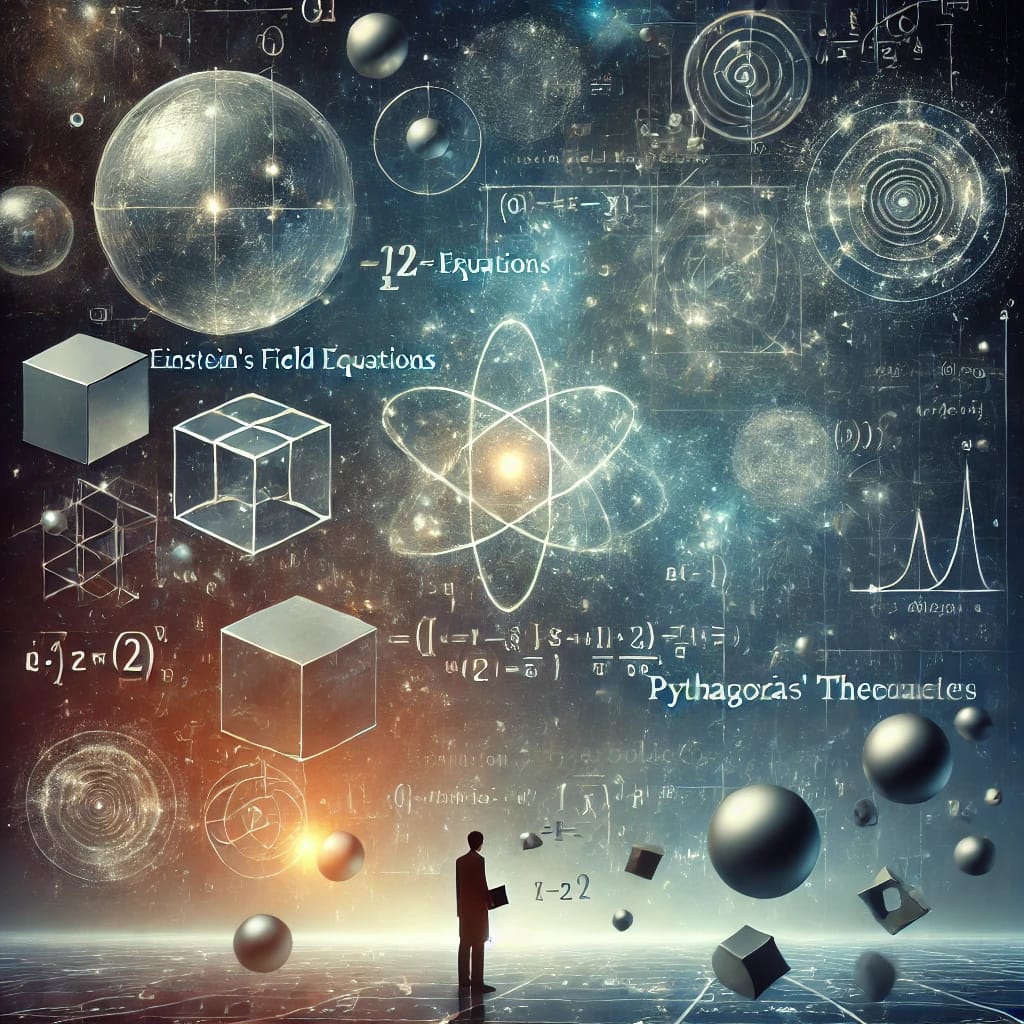
The visual representation of “famous unsolved problems in mathematics,” showcasing their mysterious and captivating nature.