Mathematics and the unknown
Mathematics Unravel the Universe’s Most Intriguing Puzzles, One Unknown at a Time
Tell me about the unknown
When referring to “the unknown” in mathematics, it often points to one of several broad categories:
- Unsolved Problems: These are questions or conjectures that have been posed but not yet resolved. Examples include the Riemann Hypothesis, which concerns the distribution of prime numbers, and the Navier-Stokes Existence and Smoothness problem in fluid dynamics.
- Unknown Constants or Quantities: In various equations or formulas, there may be constants whose exact values are not known. A famous example is the fine-structure constant in physics, which plays a crucial role in quantum mechanics but whose exact value and mathematical significance remain elusive.
- Variables in Equations: In algebra, an unknown is often a variable that represents a number we wish to find or solve for. For example, in the equation x+2=5, x is the unknown.
- Areas of Mathematical Research: There are entire fields of mathematics where much is still unknown. For instance, in number theory, we still don’t fully understand the behavior of prime numbers, and in topology, the complexities of higher-dimensional spaces offer many unanswered questions.
- Philosophical or Fundamental Questions: Mathematics also grapples with deep questions about the nature of mathematical objects, the foundations of mathematics, and the extent to which mathematics is a construct of the human mind or a fundamental part of the universe.
- Emerging Fields: New technologies and scientific discoveries often give rise to new areas of mathematical research, where much is yet to be discovered. For example, the mathematics of quantum computing is a rapidly evolving field with many unknowns.
The unknown in mathematics represents the frontier of human knowledge and understanding, a space where curiosity, creativity, and rigorous thought converge to push the boundaries of what we know.
Prime numbers and their unknowns
Prime numbers, fundamental to number theory, are integers greater than 1 that have no divisors other than 1 and themselves. Despite centuries of study, they continue to present a rich field of “unknowns” and unsolved problems. Here are some key areas of mystery and ongoing research:
- Distribution of Primes: The prime number theorem gives a general description of how primes are distributed among integers, but there are finer details that are still not fully understood. For instance, the gaps between successive primes and the frequency of twin primes (pairs of primes that differ by 2) remain areas of active research.
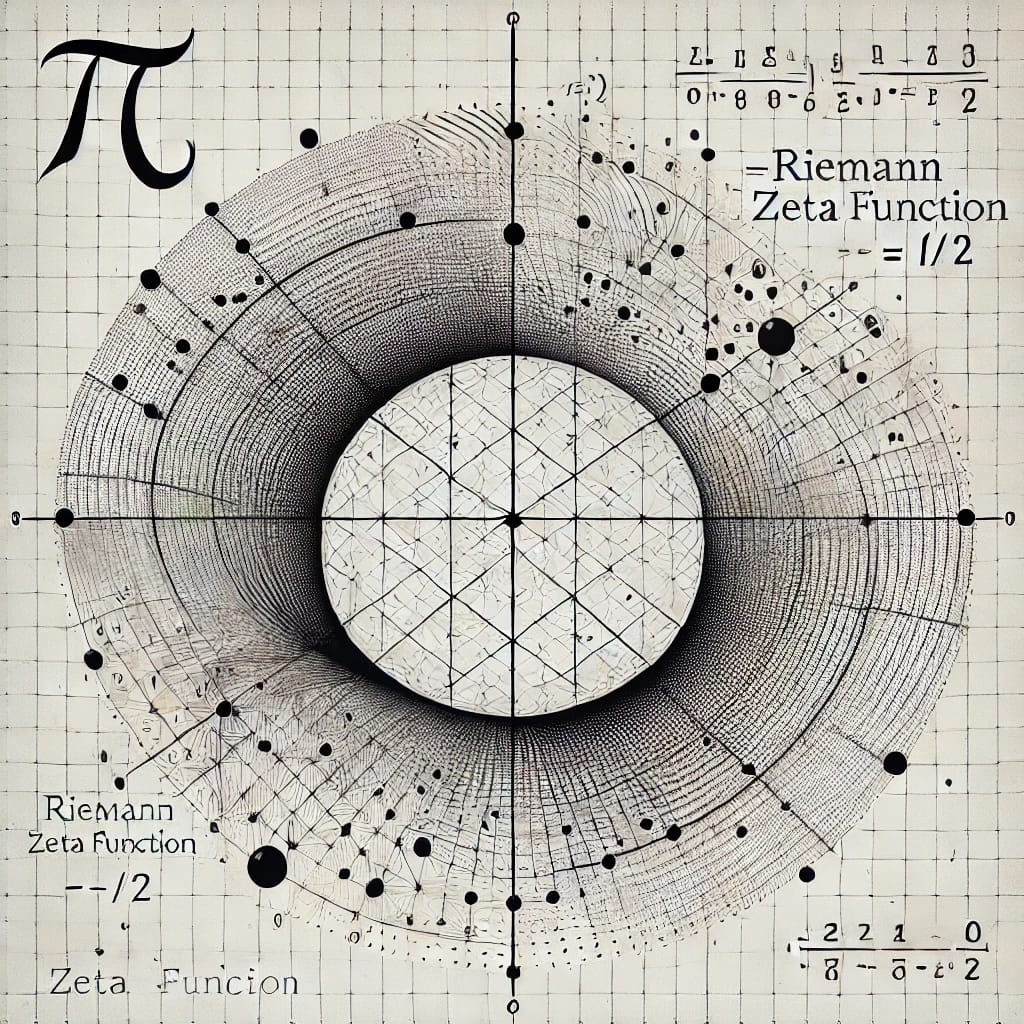
- Riemann Hypothesis: Perhaps the most famous unsolved problem in mathematics, the Riemann Hypothesis, proposed by Bernhard Riemann in 1859, relates to the distribution of prime numbers. It conjectures that all non-trivial zeros of the Riemann zeta function have their real parts equal to 1/2. Its proof (or disproof) is expected to have profound implications for number theory, particularly in understanding the distribution of prime numbers.
- Goldbach’s Conjecture: This conjecture states that every even integer greater than 2 can be expressed as the sum of two primes. Despite considerable numerical evidence supporting this conjecture, a general proof or disproof remains elusive.
- Largest Known Prime: The search for large primes, especially Mersenne primes (primes of the form
2^p – 1 where p is also a prime), is ongoing. With advances in computing, the largest known prime continues to grow, but there’s no known formula to directly calculate large primes. - Patterns in Primes: Mathematicians are still exploring whether there are discernible patterns in the occurrence of primes. While primes appear to be distributed randomly in a certain sense, there are structures and regularities, like the aforementioned twin primes, that suggest underlying patterns yet to be fully understood.
- Primes in Mathematical Cryptography: Prime numbers play a crucial role in cryptography, particularly in algorithms like RSA. The difficulty of factoring large numbers into primes forms the basis of the security of many encryption systems. Understanding the properties of primes can have significant implications for the field of cybersecurity.
- Analytic Number Theory: This field, which uses tools from analysis to study integers, is deeply intertwined with the study of primes. There are many conjectures and theorems related to the distribution and properties of prime numbers that remain partially or completely unsolved.
The study of prime numbers is a striking example of how simple definitions can lead to deep and complex questions in mathematics. The pursuit of these unknowns not only advances mathematical knowledge but also frequently intersects with other fields like computer science, physics, and cryptography.
Some hints to solve these
Solving the mysteries surrounding prime numbers often requires a blend of deep mathematical insight, advanced computational techniques, and sometimes, a bit of serendipity. Here are some hints and approaches that mathematicians use to tackle these challenges:
- Analytical Tools: Many unsolved problems in prime numbers, including the Riemann Hypothesis, require sophisticated tools from analysis, particularly complex analysis. Understanding the properties of functions like the Riemann zeta function is key.
- Computational Methods: For conjectures like Goldbach’s, extensive computational checks can provide strong heuristic evidence, though they can’t replace a proof. High-performance computing can also help discover large primes and study their properties.
- Cross-disciplinary Approaches: Insights from fields like quantum mechanics, statistical mechanics, and chaos theory have been applied to understand the distribution of prime numbers. This interdisciplinary approach can yield new perspectives and tools.
- Patterns and Heuristics: Observing patterns in prime numbers can lead to formulating conjectures. While not proofs, these heuristics can guide the direction of formal research and provide a framework for understanding the behavior of primes.
- Advanced Algebra and Number Theory: Tools from algebraic number theory, like Galois groups, algebraic geometry, and elliptic curves, are crucial in understanding primes, especially in the context of advanced conjectures.
- Cryptography and Computational Complexity: The study of prime numbers in cryptography often leads to new mathematical insights. Understanding the complexity of algorithms related to primes can also offer hints towards solving prime-related problems.
- Collaboration and Open Problems Sessions: Mathematics, more than ever, is a collaborative field. Working with others, attending conferences, and participating in open problem sessions can lead to breakthroughs.
- Historical Methods and Proofs: Studying how past mathematicians approached and solved problems related to primes can provide inspiration. Sometimes, an old technique may offer a new insight when applied in a novel way.
- Persistence and Creativity: Many mathematical breakthroughs have come from a combination of relentless effort and creative thinking. Being open to new ideas and willing to persist in the face of difficulty is essential.
While these hints and approaches offer a roadmap, solving prime number mysteries often requires stepping into the unknown and forging new paths in mathematics. The journey to these solutions is as important as the destination, contributing to the rich tapestry of mathematical knowledge.
I hope you enjoyed the ride!
Have a thoughtful day!
Make your own inventive corner
Ready to start your own website and share your passion with the world? Join me and unlock step-by-step training to build your online presence just like I did! Use my links if you want me as your coach!