Who was Bernhard Riemann
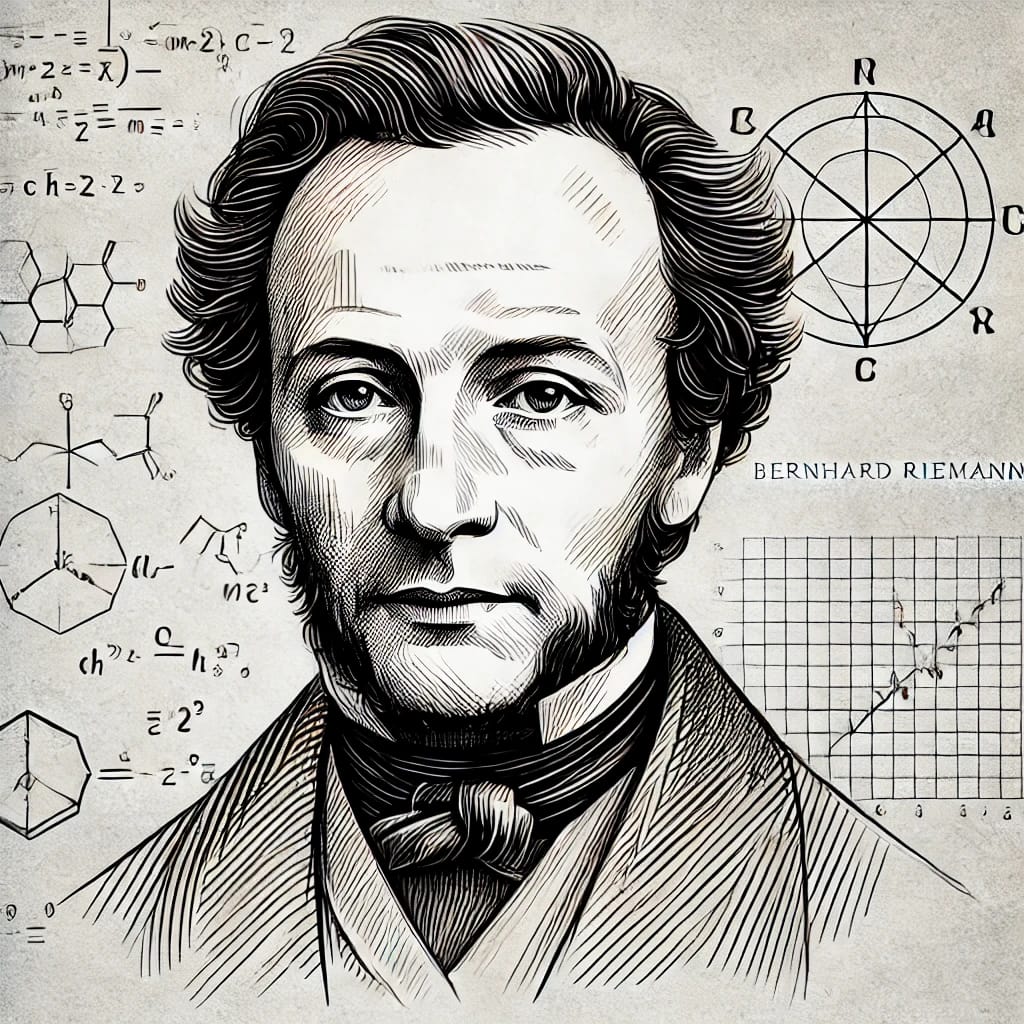
Bernhard Riemann was a pioneering 19th-century German mathematician whose work profoundly shaped modern mathematics, particularly in the fields of geometry, analysis, and number theory. Riemann’s contributions laid the groundwork for many areas of contemporary mathematics, including complex analysis, topology, and mathematical physics. Here’s an overview of his life, contributions, and his most famous theories:
Early Life and Background
- Born: September 17, 1826, in Breselenz, Kingdom of Hanover, Germany.
- Family and Education: Riemann came from a modest family and showed extraordinary aptitude for mathematics from a young age. He initially studied theology, adhering to his family’s wishes, but soon switched to mathematics due to his undeniable talent.
- University: He studied at the University of Göttingen and the University of Berlin, where he learned from eminent mathematicians like Carl Friedrich Gauss, Dirichlet, and Jacobi.
Major Contributions and Theories
Riemann’s groundbreaking work spanned several mathematical domains, and he introduced concepts that are foundational even in modern mathematics and theoretical physics.
1. Riemannian Geometry
- Riemann’s most famous contribution, Riemannian Geometry, introduced a new way of thinking about space and curvature.
- In his 1854 habilitation lecture, On the Hypotheses Which Lie at the Foundations of Geometry, he redefined geometry by generalizing Euclidean concepts, allowing the study of spaces with curvature. This framework laid the foundation for differential geometry, essential in Albert Einstein’s development of general relativity.
- Riemannian geometry examines curved spaces, where distances and angles are defined differently from flat Euclidean space. This approach allows for the study of complex shapes and structures, crucial in modern fields such as cosmology, string theory, and quantum mechanics.
2. Riemann Zeta Function and the Riemann Hypothesis
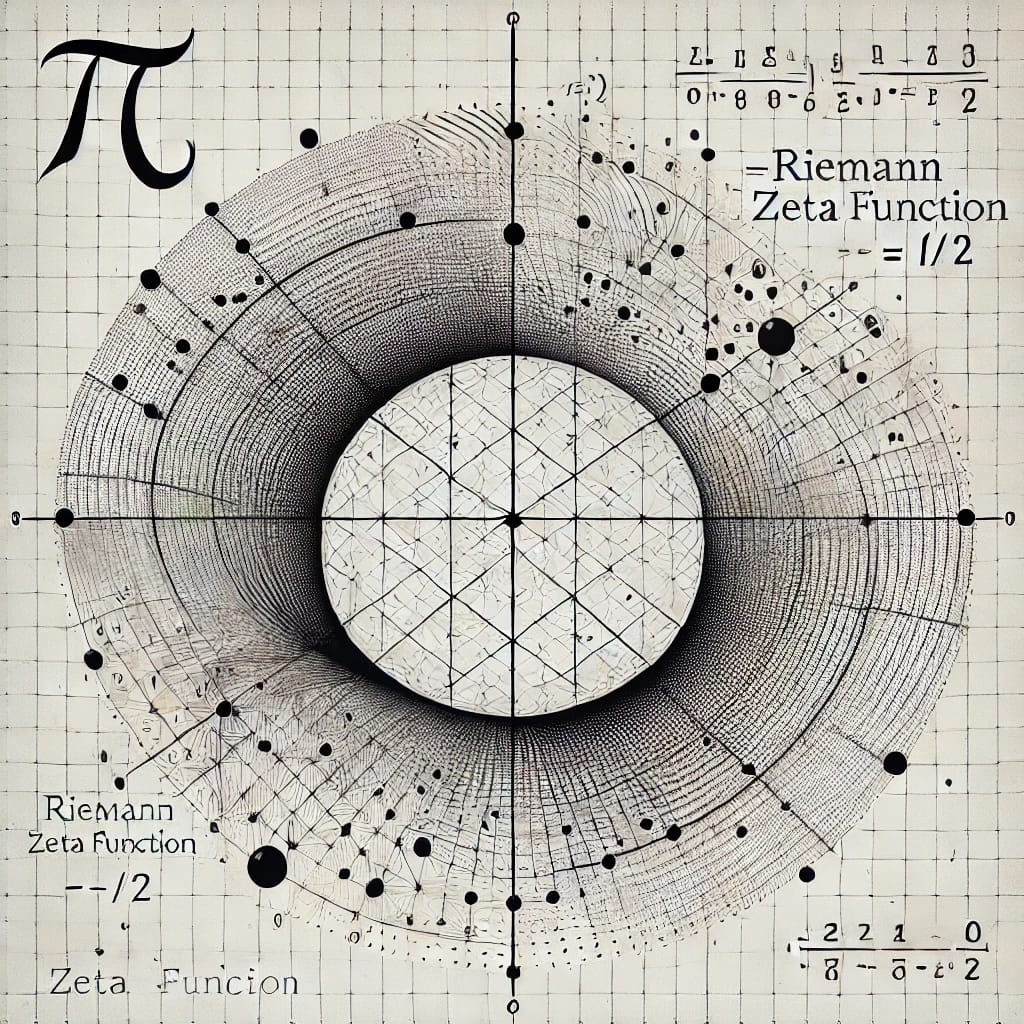
- Riemann extended Euler’s work on the zeta function, defining it for complex numbers and exploring its implications in number theory.
- In his 1859 paper On the Number of Primes Less Than a Given Magnitude, he introduced the Riemann Hypothesis, which conjectures that all non-trivial zeros of the zeta function lie on a specific line in the complex plane (the “critical line”).
- The Riemann Hypothesis is one of the most famous unsolved problems in mathematics and is part of the Millennium Prize Problems, with a reward of $1 million for a correct proof or counterexample.
3. Riemann Surfaces
- Riemann revolutionized complex analysis by introducing Riemann surfaces, a concept that provides a way to visualize and study complex functions.
- A Riemann surface is a one-dimensional complex manifold, which allows complex functions to be defined consistently even when they have multiple branches or complex roots. This concept is fundamental to modern mathematical physics, algebraic geometry, and complex dynamics.
4. Contributions to Fourier Analysis and Integration Theory
- Riemann made significant contributions to Fourier series and laid the groundwork for what would later become Lebesgue integration.
- His work on integration, especially the Riemann integral, defined a method for approximating areas under curves and became a fundamental building block of calculus and analysis.
Legacy and Impact
Riemann’s work transformed many mathematical fields and opened the door to new, previously unimaginable directions. His approach was groundbreaking because he employed intuition and deep theoretical ideas, which were uncommon at the time. His influence is widespread across:
- Physics: Riemannian geometry is indispensable in general relativity, where it describes the structure of spacetime.
- Number Theory: The Riemann Hypothesis is central in number theory, affecting our understanding of prime numbers and their distribution.
- Complex Analysis and Topology: Riemann surfaces remain critical in analyzing complex functions and connecting different branches of mathematics.
Personal and Later Years
Riemann was a reserved individual who lived a relatively quiet life, plagued by ill health for much of his career. Despite his introverted nature, he left a deep intellectual mark on his students and colleagues. Sadly, he passed away at a young age, 39, on July 20, 1866, in Selasca, Italy, due to tuberculosis.
Riemann’s vision reshaped mathematics and continues to inspire mathematicians and physicists alike. His theories remain active areas of research, from the pursuit of a proof for the Riemann Hypothesis to the use of Riemannian geometry in advanced physics and cosmology.
Your curiosity is appreciated!
Make your own inventive corner
Ready to start your own website and share your passion with the world? Join me and unlock step-by-step training to build your online presence just like I did! Use my links if you want me as your coach!