What are Spinors
Spinors are mathematical objects used in quantum mechanics and relativity to describe the properties of particles with spin, such as electrons. Unlike vectors or tensors, which transform in a straightforward manner under rotations and Lorentz transformations, spinors transform in a more complex way that captures the intrinsic spin properties of particles.
Key Features of Spinors
- Transformation Properties:
- Under a 360-degree rotation, spinors change sign (i.e., they transform to their negative). They return to their original form only after a 720-degree rotation.
- This peculiar transformation property distinguishes spinors from vectors and tensors.
- Components:
- Spinors have components that can be complex numbers.
- In three-dimensional space, a common type of spinor is a two-component spinor (often used to describe spin-1/2 particles like electrons).
- Dirac Spinors:
- In relativistic quantum mechanics, Dirac spinors are used. These are four-component objects that combine two two-component spinors.
- Dirac spinors are used in the Dirac equation, which describes particles like electrons in a way consistent with special relativity.
- Pauli Matrices:
- Spinors are often associated with Pauli matrices in non-relativistic quantum mechanics. These matrices are used to represent spin operators and help describe how spin-1/2 particles interact with magnetic fields.
- Applications:
- Spinors are fundamental in the theory of quantum mechanics, particularly in the study of fermions (particles with half-integer spin).
- They are also essential in the formulation of quantum field theories and the Standard Model of particle physics.
Mathematical Background
- Two-Component Spinors: In the non-relativistic case, spin-1/2 particles are described by two-component spinors, which are elements of a two-dimensional complex vector space.
- Four-Component Spinors: In the relativistic case, Dirac spinors are four-component objects, combining two two-component spinors to account for both particle and antiparticle solutions of the Dirac equation.
Example:
A two-component spinor for an electron might look like this:
ψ=(ψ1 ψ2 )
Here, ψ1 and ψ2 are complex numbers representing the probability amplitudes of the electron’s spin being “up” or “down” along a chosen axis.
Importance:
- Spinors are crucial for accurately describing the quantum states of particles that obey Fermi-Dirac statistics, which include all known fundamental particles except bosons (which have integer spins and are described by other mathematical objects).
Understanding spinors is essential for advanced studies in theoretical physics, especially in areas dealing with fundamental particles and their interactions. They provide a more complete and nuanced description of particle behavior, especially when considering the principles of quantum mechanics and relativity.
Can spinors been used for free energy
Spinors themselves are not directly related to the concept of free energy or the development of free energy devices. Spinors are primarily mathematical tools used in quantum mechanics and relativity to describe particles with spin. Free energy concepts, particularly those claiming to produce energy without conventional fuel sources or exceeding traditional efficiency limits (often referred to as over-unity devices), fall into a different domain of physical investigation and technological development.
Free Energy Concepts and Spinors
- Quantum Mechanics and Spinors:
- While spinors are crucial for understanding the quantum mechanical behavior of particles, they do not inherently provide mechanisms for free energy production. Quantum mechanics, which uses spinors, deals with the fundamental properties and interactions of particles, rather than macroscopic energy production.
- Theoretical Physics:
- In theoretical physics, particularly in areas like quantum field theory and particle physics, spinors are used to describe the properties of fundamental particles. These fields explore the fundamental forces and particles of the universe but do not directly address practical energy generation technologies.
- Free Energy Research:
- Free energy research often involves concepts like zero-point energy, vacuum fluctuations, and other advanced physical theories. While these areas sometimes overlap with quantum mechanics, the practical application of these theories to create free energy devices remains speculative and highly controversial.
- Claims of free energy devices often lack empirical support and rigorous scientific validation. For instance, over-unity devices, which claim to produce more energy than they consume, violate the principle of conservation of energy, a fundamental tenet of physics.
Critical Evaluation
- Scientific Rigor: Any claim of a free energy device must be critically evaluated using established scientific principles. It is crucial to distinguish between theoretical possibilities suggested by advanced physics and practical, demonstrable technologies.
- Empirical Evidence: Free energy devices need to be substantiated with empirical evidence and reproducible results. Many purported free energy devices fail under rigorous testing or lack independent verification.
Conclusion
While spinors play a vital role in our understanding of quantum mechanics and the behavior of fundamental particles, they do not directly contribute to the development of free energy technologies. Free energy remains a highly speculative field, and any claims should be approached with scientific skepticism and require thorough validation. The connection between advanced theoretical concepts and practical energy generation remains tenuous and largely unproven.
What would be an appropriate image to illustrate the article
To illustrate an article that explains spinors and their relevance in physics, you could use an image that visually represents the following concepts:
- Quantum Mechanics and Spin:
- A visual representation of a particle with spin, such as an electron, showing its spin states (up and down).
- A depiction of Pauli matrices and how they relate to spinors.
- Transformation Properties:
- An illustration of how spinors transform under rotations, emphasizing the 360-degree rotation leading to a sign change and the 720-degree rotation returning to the original state.
- Dirac Equation:
- A graphic showing the Dirac equation and its components, illustrating how Dirac spinors are used in relativistic quantum mechanics.
- Mathematical Representation:
- A depiction of a two-component spinor and a four-component Dirac spinor, showing their structure and components.
Prompt for Image Generation:
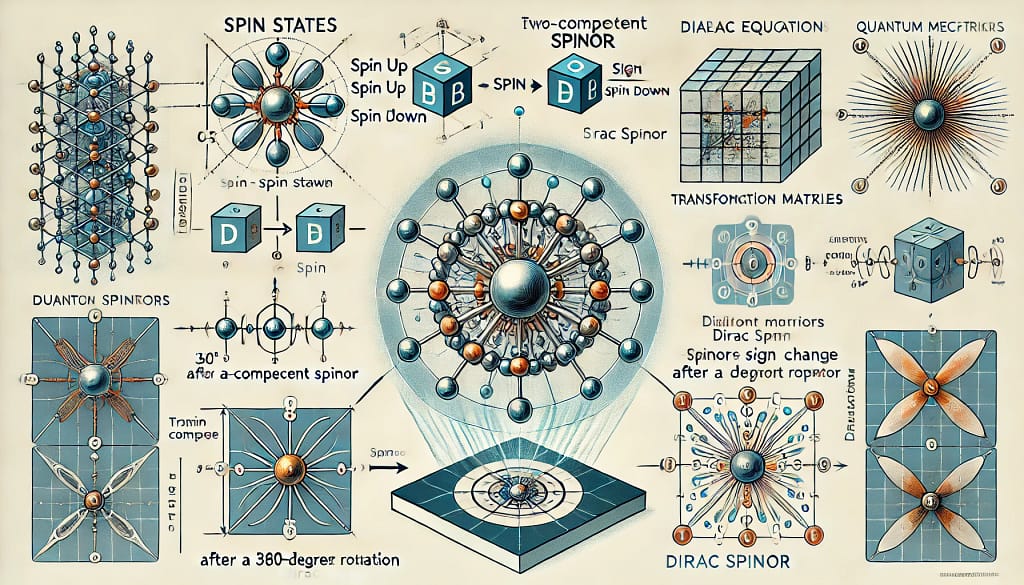
“Create an illustration to explain spinors in quantum mechanics and their applications. The image should include the following elements:
- A depiction of an electron with its spin states (spin up and spin down).
- Visual representation of Pauli matrices with labels.
- A transformation diagram showing a spinor’s sign change after a 360-degree rotation and returning to its original state after a 720-degree rotation.
- The Dirac equation with labeled components, indicating the use of Dirac spinors.
- A graphical representation of a two-component spinor and a four-component Dirac spinor, with annotations explaining their structure. Use a scientific and educational style, incorporating clear and concise labels.”
This image would effectively illustrate the key concepts discussed in the article and help readers understand the mathematical and physical significance of spinors.