The New Space Age Beyond our Solar System
The New Space Age. Breakthroughs Fueling Humanity’s Leap Beyond Earth
Not long ago, launching a single satellite was enough to make global headlines. Today? We’re deploying AI-driven probes, designing Martian habitats, and turning space into a new commercial frontier. The space age isn’t just alive. It’s evolving faster than ever, fueled by breakthroughs that were once the stuff of science fiction.
What was once a race between superpowers is now a collaborative, high-tech sprint involving nations, startups, AI systems, and even billionaires with bold visions. From SpaceX’s reusable rockets to AI-guided planetary exploration, this is a new era. Where space isn’t the final frontier, but the next platform for innovation, survival, and perhaps civilization itself.
Rocket Science Reimagined with Reusability, Ion Drives & the Edge of Impossible
Rocket propulsion is no longer just about brute force—it’s about elegance, efficiency, and evolution. Chemical propulsion, the tried-and-true engine of the Apollo era, now shares the stage with:
- Reusable launch systems (SpaceX’s Falcon 9, Rocket Lab’s Electron): turning million-dollar launches into something closer to airline operations.
- Ion and plasma drives: futuristic systems that don’t explode with power but whisper across the stars, delivering slow, steady, ultra-efficient thrust—perfect for long-haul space travel.
These new technologies aren’t just incremental improvements. They’re paradigm shifts, dramatically slashing launch costs and redefining what’s possible. Expect to see interplanetary cargo freighters, deep-space probes, and even AI-managed drone fleets exploring moons and asteroids autonomously.
From Mission Control to Machine Control. The Rise of AI in Space
The real pilot of the future? Not human. Not even close.
Modern space missions rely increasingly on Artificial Intelligence, and not just for crunching numbers. AI systems now:
- Navigate rovers across Martian cliffs and lava tubes (see: Perseverance’s self-driving capabilities)
- Analyze astronomical data from telescopes like James Webbfaster than any team of humans could
- Coordinate massive satellite constellations like 3i/Atlas to monitor Earth’s climate, communications, and conflict zones in near real-time
AI doesn’t sleep, doesn’t panic, and—thanks to machine learning—improves with every mission. This isn’t automation for convenience. It’s intelligence for survival. Whether it’s a glitch mid-mission or a sudden solar flare, AI can respond in microseconds—faster than a command could even reach from Earth.
And looking ahead? Imagine AI copilots on manned Mars missions, neural interface tools, or symbiotic AI-human teamwork during asteroid mining or deep-space colonization. This is no longer theoretical. It’s underway.
Building the Future with 3D Printing, Smart Materials, and Autonomous Factories in Space
Designing spacecraft today looks nothing like it did 20 years ago. We’re now entering the age of:
- 3D-printed spacecraft components, both on Earth and in orbit
- Self-healing materials that adapt to micrometeoroid damage
- Modular, AI-designed habitats that can be printed on Mars using local regolith
Companies like Relativity Space and Made In Space are proving that spacecraft manufacturing doesn’t need massive Earth-based facilities. The future is on-demand, on-orbit, and on-point.
This shift also aligns with the vision of in-situ resource utilization (ISRU)—using lunar or Martian materials to build infrastructure. Why ship from Earth when you can manufacture onsite?
From Tourists to Settlers? The Real Rise of Commercial Space
What once seemed like a billionaire’s vanity project is now an emerging industry with real economic and technological traction. Space tourism is the headline—but the underlying revolution is in commercial launch, satellite services, and orbital infrastructure.
- Blue Origin and Virgin Galactic are launching civilians
- Axiom Space is building private space stations
- SpaceX’s Starship is the first vehicle designed to carry both tourists and terraforming equipment for Mars
We’re approaching a tipping point where “going to space” will no longer be reserved for astronauts or elite scientists. It’ll be open to researchers, artists, educators—even influencers.
But with access comes responsibility. Space debris management, ethical tourism, and orbital traffic control are already pressing concerns. Organizations like LeoLabs and ClearSpace are building the orbital equivalent of air traffic control—and even garbage trucks.
Humanity’s Grand Leap with Challenges, Collaboration & Cosmic Destiny
Looking forward, the challenges become more profound—and more inspiring.
- Space debris could choke orbital access unless actively cleared.
- Radiation shielding and psychological health must be solved for deep-space survival.
- Sustainable life support systems are essential for Mars and beyond.
- Global collaboration is critical. From the Artemis Accords to China’s Tiangong Station, shared knowledge—not competition—will define the next century of space.
And then there are the wildcards:
- Quantum communication for interplanetary links
- Space-based solar power stations
- Terraforming concepts that merge biology, AI, and planetary engineering
Projects like ATLAS (AI-Tethered Large Array Satellite) hint at a future where AI not only helps navigate space, but helps us understand and shape it.
Final Orbit… Why Space Exploration Matters… To All of Us
This isn’t just about rockets or tech. It’s about perspective. Space forces us to think big, collaborate globally, and imagine boldly. The breakthroughs happening now are shaping how we live on Earthjust as much as they’re building humanity’s off-world future.
Every satellite launched, every AI-guided rover deployed, every 3D-printed habitat built is a step toward a world where Earth is just one of many homeworlds.
So whether you’re a student, an engineer, an investor (or just a dreamer) the future of space is something you can be part of.And it’s happening faster than you think.
✨ Stay Curious. Stay Grounded. Shoot for the Stars.
Let us think big. The launch of a future interstellar object (not just sending a spacecraft to orbit or even to Mars, but propelling something beyond our solar system) is the kind of vision that blends cutting-edge science, speculative tech, and philosophical stakes all at once.
Let’s explore this with a dynamic narrative snippet and tie it to present-day advances like AI, 3i/ATLAS, and breakthrough propulsion systems.
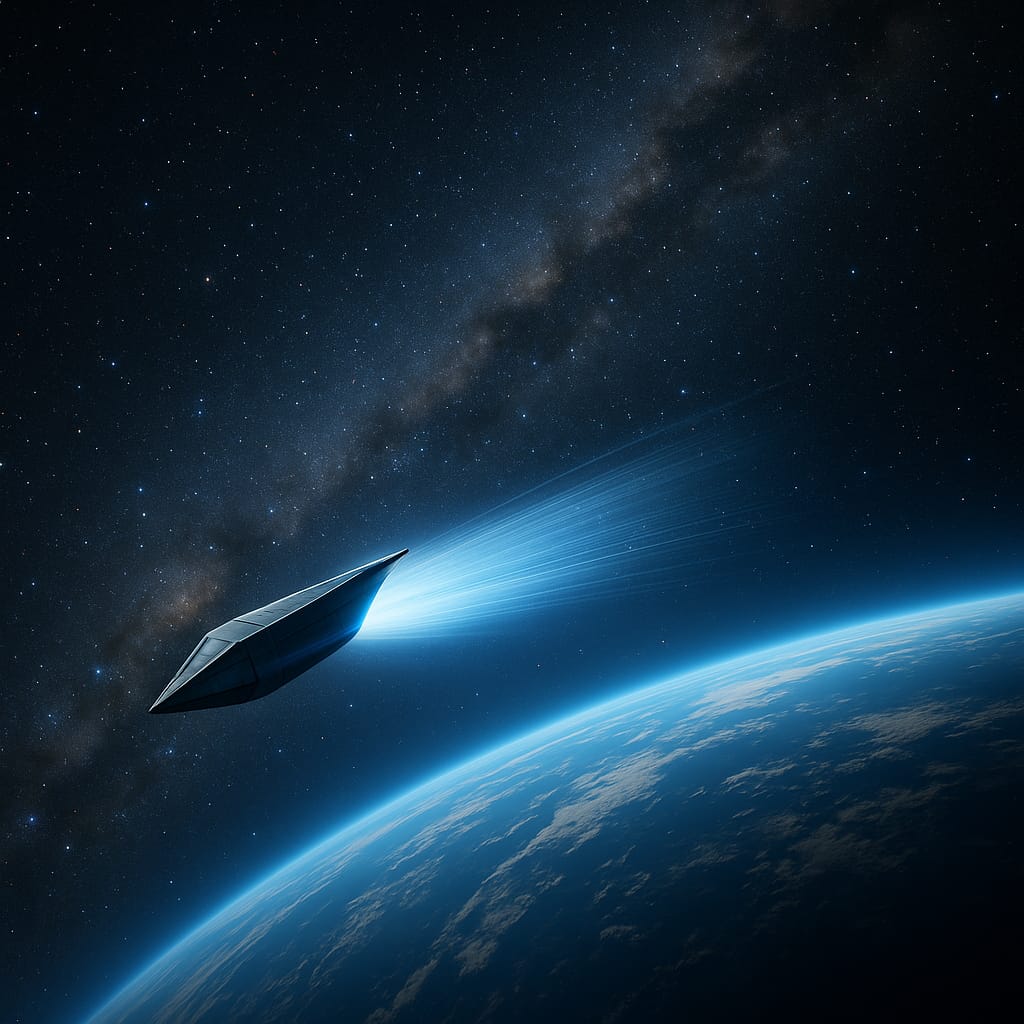
Project Stardust … Launching Humanity’s First Interstellar Messenger
In the not-so-distant future, humankind will do something profoundly symbolic… and scientifically daring: launch the first interstellar object built by human hands.
Not a probe, not a satellite. But an autonomous vessel designed to leave the solar system forever. A cosmic message in a machine, carrying with it our data, our art, our code, and our questions.
This won’t be a Voyager-style relic drifting aimlessly through space. It will be:
- AI-guided, continuously learning as it traverses alien environments
- Powered by next-gen propulsion—perhaps laser sails, nuclear fusion, or even quantum ion drives
- Constructed using autonomous orbital factories, supplied by in-situ resources from asteroids or lunar materials
Its mission? Unknown. Its path? Dynamic. But its existence will mark a new epoch: Humanity as an interstellar species.
Imagine 3i/ATLAS serving as the “hive-mind” that helped plan its course, using petabytes of Earth-observation data to ensure its launch didn’t interfere with orbital traffic or natural rhythms. Imagine AI systems writing its onboard “diary,” documenting cosmic phenomena for centuries after Earth loses signal.
More than a scientific mission, this is a gesture: a symbolic leap across the darkness, declaring that we were here… and we dared to leave fingerprints on the void.