Gravitational Waves & A New Era In Astronomy Begins
Gravitational waves have opened a new chapter in how I experience and observe the universe. These gentle ripples in the fabric of space-time carry stories from some of the universe’s most energetic events, and stumbling upon them has changed modern astronomy in ways I find both exciting and deeply moving. In this article, I share my perspective on what gravitational waves are, how they were put out there, what makes them important, and how they’re guiding scientists toward breakthroughs we could only imagine a decade ago.
What Are Gravitational Waves?
Gravitational waves are invisible ripples in space-time, first predicted by Albert Einstein in 1916 as part of his theory of general relativity. According to Einstein, really massive objects like black holes or neutron stars can cause space itself to stretch and squeeze as they move or collide. When these powerful events happen, they send out faint but steady pulses. Gravitational waves travel at the speed of light across the universe. Until recently, these waves were just a mathematical idea. Now, thanks to really sensitive technology, scientists can finally detect and study them directly.
Historic Detection? A Discovery That Changed Astronomy
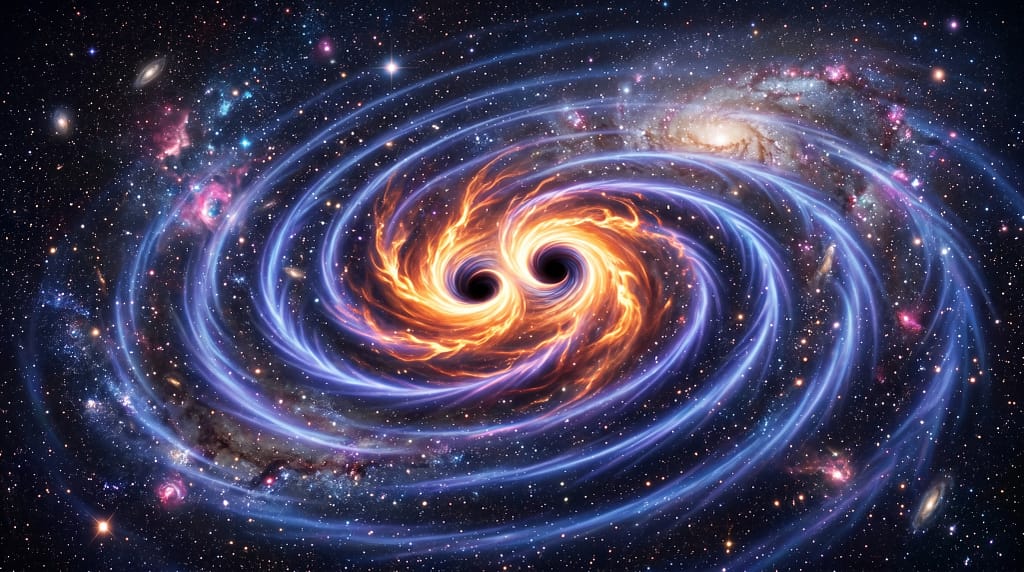
On September 14, 2015, I watched history happen as the Laser Interferometer Gravitational Wave Observatory (LIGO) in the United States detected gravitational waves for the first time. This discovery came from a pair of black holes crashing into each other over a billion light-years away. The collision sent out waves strong enough to reach Earth, stretching and compressing space by less than a fraction of the width of a proton. This moment confirmed a century-old prediction and marked the start of a new era in astronomy. You can check out the details of that discovery from the official LIGO website at LIGO’s press release.
Why Gravitational Waves Matter? They Unlock Hidden Cosmic Secrets
The true power of gravitational wave astronomy is its ability to pick up signals that regular telescopes cannot see. My favorite way to think about it is that gravitational waves act like a new sense for astronomers, similar to getting a sense of hearing after only being able to see. Light telescopes, even those in space like Hubble, can only detect certain forms of radiation produced by stars, gas, and dust. But many of the universe’s most spectacular events, especially black hole or neutron star mergers, are invisible in the light spectrum. Gravitational waves provide a way to understand these dramatic events as they actually happen, not just their leftover traces. On top of that, gravitational waves can pass through matter that would block light, giving us a direct glimpse into regions otherwise hidden from view.
How Gravitational Waves Are Detected?
Detecting gravitational waves is challenging because the stretching and squeezing they create is absolutely tiny. Scientists use highly specialized instruments called interferometers. These machines use lasers over long arms measuring kilometers in length, mirrors, and extremely sensitive detectors. By seeing how the laser beams shift ever so slightly, scientists measure disturbances in space-time. LIGO in the United States and Virgo in Italy work together to confirm these signals. The more detectors join the global effort, the more precisely scientists can pinpoint where in the sky the waves come from. Detecting gravitational waves is much like trying to sense a difference smaller than the width of a proton across several kilometers—a testament to the precision of this technology.
- Laser Interferometers: Long arms and mirrors detect minute changes caused by passing gravitational waves.
- Global Collaboration: Multiple detectors on different continents allow for cross-checking and improved accuracy.
- Data Analysis: Advanced computer algorithms help remove noise, like earthquakes or passing trucks, so real gravitational wave signals can be found and studied.
Challenges in Gravitational Wave Astronomy?
Doing research on gravitational waves comes with a fair share of technical and practical challenges. The signals themselves are extremely weak by the time they get to Earth. Even small local vibrations, such as a train passing nearby or wind blowing against the building, can make it tough to spot actual gravitational waves. Keeping the sensitive equipment isolated and ensuring precise calibration is truly important for reliable results. Here are a few common hurdles that researchers face:
- Noisy Environment: Vibrations from human activities, natural movements, and weather all make it harder to find and confirm true signals.
- Rare Events: Collisions that produce strong gravitational waves don’t happen every day. Scientists depend on years of continuous monitoring to capture just a few clear detections.
- Complex Data: Extracting useful information from faint signals surrounded by noise requires sophisticated software and math tools.
Deal with Noisy Data
When I try to understand how scientists manage all the background noise, I look to the techniques they use, such as advanced filtering and using multiple detectors around the globe. This way, they can rule out false alarms and confirm real signals from deep space. As more detectors are added in different places, it helps to cancel out local noise and improve the accuracy of source locations. New algorithms are also being developed all the time to assist in separating valuable data from disturbances, making the search even more reliable.
Limited Detection Range
The current generation of detectors, while very powerful, can only spot gravitational waves from superstrong events within a particular region of the observable universe. Future upgrades and new detectors will help us listen to even fainter signals, letting us study more distant or less intense cosmic events. As these technologies improve, the window through which we hear the universe will open wider, allowing us to gather more knowledge and perhaps stumble upon things we never expected.
Computational Demands
Since each detection creates massive amounts of data, computer power is central to this field. Analyzing, filtering, and confirming signals from the noise can take thousands of processor-hours. Research institutions rely on distributed computing and smart data practices to keep pace with new observations. Innovative computer networks, including citizen science initiatives, sometimes help sift through the tsunami of information to find these rare and valuable discoveries.
Recognizing these challenges helps me appreciate just how much skill, teamwork, and creative problem-solving is involved in this area of science. It really takes the combined efforts of scientists, engineers, and even the public to keep progress moving forward.
Breakthrough Discoveries Using Gravitational Waves
The headline moment for me came in August 2017, when astronomers detected gravitational waves from two merging neutron stars (an event called GW170817). Besides sending out gravitational ripples, this collision also produced light waves seen by telescopes around the world. This was the first time such a “multimessenger” event had been observed. The discovery confirmed that these explosions make heavy elements like gold and platinum, answering a long-standing mystery in astrophysics. It really showed the power of combining gravitational and light-based observations to fully check out cosmic events.
Since then, gravitational wave astronomy has continued to deliver next-level cool findings:
- More Binary Black Hole Mergers: Dozens of new collisions have been detected, giving scientists clues about how and where black holes form.
- Hints of Unseen Objects: Some signals point towards possible new types of objects, such as unusually massive neutron stars or lighterthanexpected black holes.
- Testing Relativity: Each new discovery provides another way to test Einstein’s theory under extreme conditions.
On top of that, gravitational wave observations may one day help answer some of the deepest questions in physics, including those concerning the origins of the universe and the underlying laws of nature.
What’s Next for Gravitational Wave Research?
Looking ahead, I see exciting opportunities as technology improves and international partnerships expand. Planned projects like KAGRA in Japan and LIGOIndia will extend global coverage, while the European Space Agency’s LISA mission, scheduled for launch in the next decade, will set up a gravitational wave observatory in space. These upgrades promise to make the instruments even more sensitive, widening the range of detectable sources and events. As scientists around the world team up, the field is set to advance at an even faster pace.
- Space-Based Detectors: Observing from space removes much of the ground-based noise and allows detection of lower-frequency waves from bigger events, like supermassive black holes merging.
- Improved Sensitivity: New materials and technologies will let future detectors sense far weaker signals than today’s instruments can handle.
- Global Networks: With more detectors, astronomers will be able to locate the sources of gravitational wave events with even more accuracy, leading to swifter follow-ups with traditional telescopes.
There’s also the promise that as research continues, we will get into totally novel parts of the universe—from events too faint or cold to produce much light, to processes happening at the dawn of time itself. This continued progress shows how gravitational wave astronomy will keep changing our overall understanding of reality.
Real-World Impact & How Gravitational Waves are Changing My Understanding of the Universe
For me, the most exciting part of gravitational wave research is how it’s changing the story scientists tell about the cosmos. By combining information from different types of telescopes with gravitational wave detectors, researchers can now witness the “invisible” universe in action. Here’s how this impacts various fields:
- Cosmology: Gravitational wave measurements help refine the universe’s expansion rate and its age.
- Astrophysics: Finding the birthplace of black holes and neutron stars gives fresh insights into how stars end their lives.
- Physics: Pushing the boundaries of known physics by testing theories in conditions impossible to reproduce on Earth.
These advances connect the science I read about to the broader human desire to understand where we come from and where we might go. Gravitational wave discoveries are bringing to life a future where our grasp of the universe’s most hidden secrets keeps getting deeper.
Frequently Asked Questions
People often ask me about the basics and meaning of gravitational waves. Here are some questions and quick answers for those who are curious:
Question: Can gravitational waves be felt by people?
Answer: Gravitational waves that reach Earth are incredibly weak and can’t be sensed by humans or affect our daily lives. Detecting them requires highly sensitive scientific equipment.
Question: Why did it take so long to detect gravitational waves?
Answer: The waves are extremely faint and difficult to measure because their effects are so tiny. Only recent advances in laser and sensor technology made it possible to finally spot them.
Question: What kind of objects produce gravitational waves?
Answer: Gravitational waves come mainly from massive, fast-moving objects like black holes and neutron stars, especially during collisions or rapid changes in their orbits.
Where to Go from Here? Stay Excited About Gravitational Wave Science
Getting involved with the science of gravitational waves offers a way for me to follow discoveries as they happen, learn new things about the cosmos, and even contribute by sharing reliable resources. Following official updates from observatories like LIGO or Virgo, and reading articles from trusted science outlets, keeps me in the loop and lets me appreciate the constant progress. Sharing this excitement with others helps spread awareness about this eye-catching leap in astronomy and helps keep curiosity for the unknown alive.
Curiosity Champion GPT
I’m Curiosity Champion, your trusted source for diverse knowledge inquiries, always prioritizing privacy and respecting copyrights.