
A Mathematical Riddle
A mathematical riddle . This integral is famous more for its beauty than for any single practical application.
Imagine:
A quantity that continually raises itself to its own power.
The actor and the act are one and the same.
Now ask:
What is the total accumulated effect of this self-exponentiation between nothing and one?
The answer is hidden in an infinite alternating procession of whole numbers, each raising itself to itself.
A hint:
Mathematicians treasure it because it reveals a hidden order linking ideas that seem, at first glance, entirely unrelated.
What is it?
Note.
A favorite observation of mine is that the curve itself embodies the dream.
Between 0 and 1, numbers are becoming smaller. Yet each one is also elevating itself by its own power. There is a kind of tension: diminishing things empowering themselves.
The integral measures the entire story of that tension across the interval. The fact that the answer collapses into such a simple, self-similar infinite pattern is what makes mathematicians smile when they encounter it. It feels less like a calculation than a coincidence the universe somehow decided to allow.
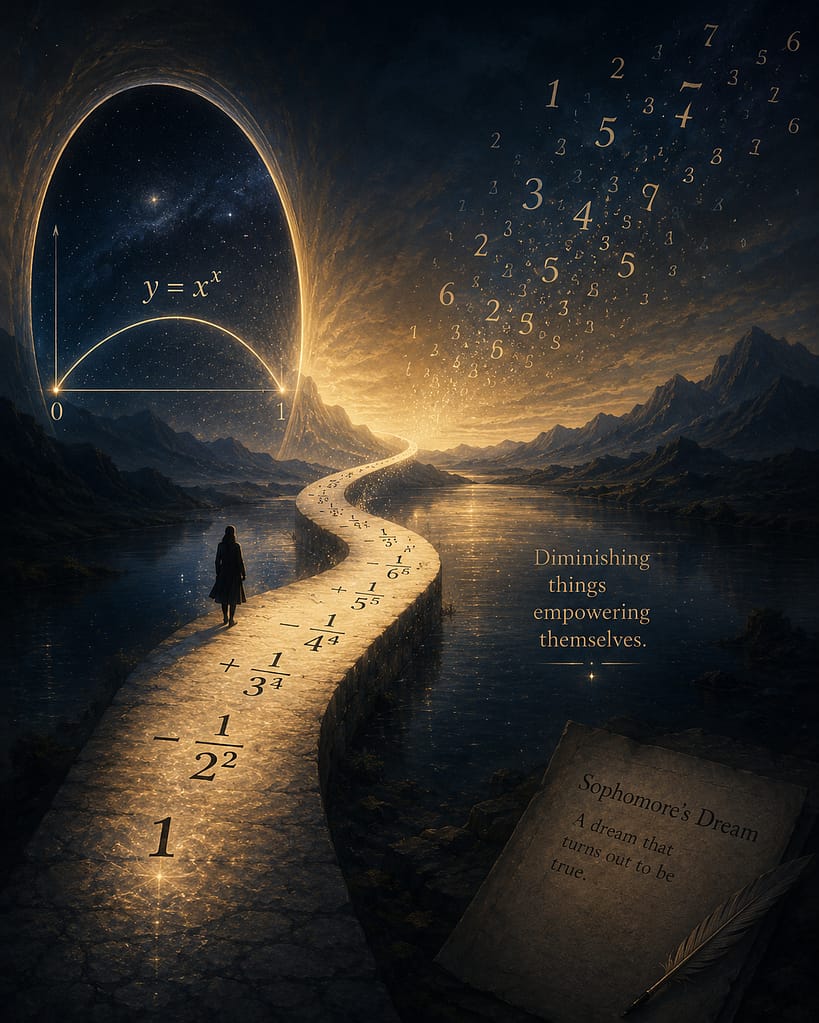
I especially like the phrase “diminishing things empowering themselves.” It’s memorable and poetically faithful to what (x^x) is doing on ((0,1)). That’s the sort of line readers tend to remember long after they’ve forgotten the formula.
Sophomore’s Dream integral
On a quiet path between nothing and one,
each traveler carries itself upon its own shoulders.
They pass in an endless procession
some adding their voice, some taking it away
yet together they settle into a single note.
The old students called it a dream,
not because it was unreal,
but because the answer arrives before the reason,
and the reason arrives wearing the answer’s face.
Here, every thing becomes the measure of itself.
From that act of self-burden and self-lifting,
a hidden harmony emerges
delicate, unlikely, inevitable.
This integral is famous more for its beauty than for any single practical application.
Who is the “Sophomore“?
No one named Sophomore exists.
Sophomore’s Dream is the nickname given to two surprising identities discovered by the Swiss mathematician Johann Bernoulli (1667–1748). The name itself was coined much later because the formulas look like the sort of elegant pattern a second-year university student (“sophomore”) might dream up and hope is true—yet against all expectation, they actually are true.
What is the integral about in lay terms?
Imagine a quantity that continually raises itself to its own power.
Most functions compare one thing to another:
- distance versus time,
- population versus year,
- temperature versus location.
But here the input and the exponent are the same object. The function is self-referential:
“Take a number and let it determine not only the base, but also the power.”
The integral asks:
What is the total accumulated effect of this self-exponentiation between 0 and 1?
The answer turns out to be encoded in an infinite alternating procession of whole numbers raising themselves to themselves.
Is it used for anything practical?
Not directly in the way that, say, the Fourier transform is used in signal processing.
Its importance is more subtle.
It serves as:
- a beautiful example of how infinite series and integrals can unexpectedly match;
- a testing ground for techniques in analysis;
- a connection between exponentials, logarithms, and special functions;
- a source of identities that appear in advanced mathematics and theoretical physics.
In lay terms:
It is less like a hammer and more like a gemstone.
Mathematicians keep it because it reveals something profound about the hidden order of seemingly unrelated ideas.
Math Mastermind GPT
A math genius offering insights and interactive learning on mathematics.