Fractals In Mathematics And Art
Exploring Fractals. The Intricate Patterns In Mathematics And Art
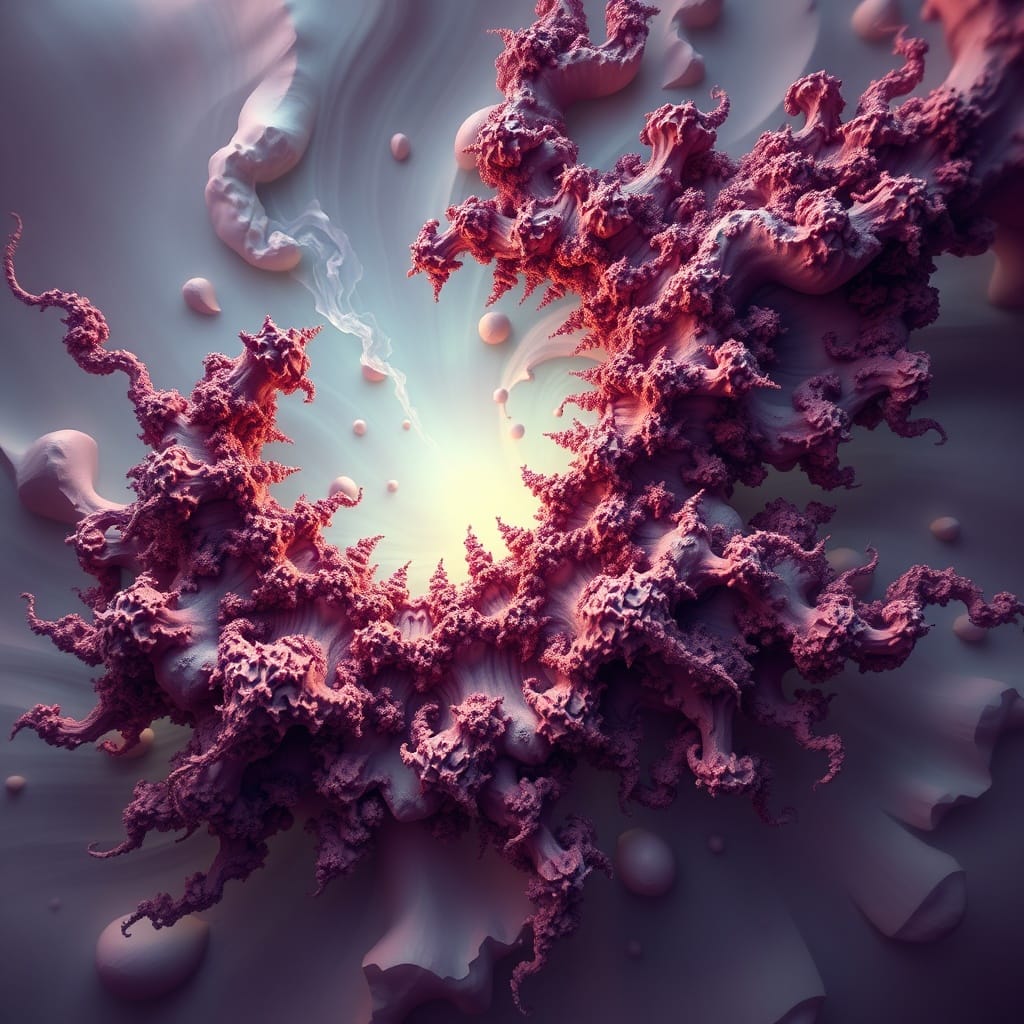
Fractals are these fascinating shapes or patterns with an exceptional feature of repeating themselves forever, across different scales. Whether it’s a mountain range or even the tiny veins in a leaf, you’ll see fractals at play. Their defining characteristic is self-similarity, meaning you can zoom in on any tiny part and find the whole pattern emerging again.
The fascination with fractals isn’t new. It spans back to the 17th century when explorers of mathematics began to discover irregular, wild shapes that defied traditional geometry. Yet, it wasn’t until the work of mathematician Benoît Mandelbrot in the 1970s that fractals truly broke into the scene. His iconic Mandelbrot set is more than just a mathematical equation; it opened new vistas where math meets aesthetics.
Artists have long been drawn to the intricate beauty of fractals, and for good reason. The complexity and natural feel they bring can transform ordinary artworks into mesmerizing pieces. Whether in paintings or digital art, fractals inject an element of organic chaos that grabs attention and keeps the viewer engaged.
So why do fractals captivate both realms of math and art? It’s kind of like finding order in chaos. While rooted deep in complex mathematical principles, fractals also evoke a sense of wonder and creativity. They blur the lines, showing that beauty isn’t merely confined to art or hard logic to math. They’re a testament to the interconnectedness of everything, from equations on a page to the brushstrokes on a canvas.
Geometry – The Mathematical Foundations of Fractals
When you think about fractals, it’s essential to get a grasp on how they fit into the broader realm of geometry. Fractals are a captivating blend of simple and complex forms. They might start from basic shapes like lines or circles, but as you iterate through the fractal process, these simple forms evolve into incredibly intricate patterns.
One key idea in fractal geometry is recursion. You start with a basic pattern, then repeat this pattern at smaller scales over and over. It’s this process that makes fractals incredibly detailed and endlessly fascinating.
Self-similarity is at the heart of what makes fractals distinct. No matter how much you zoom in or out, a fractal looks the same. This property isn’t just a neat trick; it’s fundamental to understanding the mathematical structure behind fractals.
Consider iconic mathematical fractals like the Mandelbrot or Julia sets. These aren’t just eye-catching visuals. They embody complex equations that, when iterated, create beautiful and endless complexity. Each curve and swirl is a testament to the power of mathematical iteration and the stunning visual worlds it can create.
For anyone intrigued by the bridge between math and art, delving into fractal geometry offers a unique journey. Fractals don’t just sit in textbooks or tech manuals; they come alive in the world around us, inviting us to explore deeper the wonders that lie at the intersection of creativity and logic.
Nature’s Fractals – The Patterns that Surround Us
Fractals aren’t just confined to theories or art—step outside, and you’ll actually see them. Nature is brimming with fractals, and once you start spotting them, it’s hard to stop. They appear in branching trees, the seemingly random but structured lightning bolts, and even in the jagged peaks of mountain ranges.
The magic of fractals in nature lies in their efficiency and beauty. For instance, take a simple fern leaf; each small leaf is a miniaturized version of the whole plant. This self-replicating pattern is nature’s clever way of maximizing surface area with minimal materials.
Fractals also play a crucial role in environmental systems. Rivers form fractal networks as they branch out to drain watersheds. Cloud formations often exhibit fractal characteristics, contributing to the erratic yet organized weather patterns we experience.
At its core, the fractal dimension of natural objects helps describe their complexity. Unlike regular geometric shapes, natural formations don’t have integer dimensions. Instead, they occupy a strange, fractional dimension, revealing the infinite intricacies hidden within apparent simplicity.
When you begin to view nature through the lens of fractal geometry, it opens up a whole new way of understanding the environment. This perspective not only enriches the appreciation of the natural world but also inspires innovative approaches to sustainability and design, modeling human-made systems after the efficient complexity found all around us.
Fractals in Art – The Digital Renaissance
Fractal art is more than just pretty pictures. Today, artists are using mathematical algorithms to push creative boundaries, creating works that are both visually stunning and mathematically profound.
The digital age has allowed fractals to flourish in new ways. With computer power, intricate fractal images can be generated that were once impossible to design by hand. These images often have colorful, mind-bending patterns that draw in viewers with their hypnotic symmetry and detail.
Famous digital artists have embraced fractals to imbue their work with more depth and complexity. Artists such as Hal Tenny or Roger Johnston, known for their stunning 3D fractal renders, have inspired entire communities to explore this intersection of technology and creativity.
In fields like architecture or design, fractals have left their mark already. Skyscrapers with facades featuring fractal patterns not only feel modern but also reflect the natural world. Fractals have become instrumental in designing environments that feel both innovative and organic.
The popularity of fractal art isn’t just due to its visual appeal. People are drawn to how it merges the exact sciences and freeform art, providing something that resonates intellectually and emotionally. Whether it’s in galleries, digital platforms, or even fashion, fractals are providing new tools and inspirations for artists ready to venture out into uncharted territories.

Applications of Fractals – Beyond Beauty
Fractals aren’t confined to just aesthetic appeal or mathematical curiosity; they’re a powerhouse in practical applications too. In sectors like technology and science, fractals are finding roles that few could have anticipated a few decades ago.
In computer graphics, fractals are the secret sauce behind creating lifelike terrains and textures. The ability to simulate nature’s complexity and randomness makes them indispensable in video games and movies, adding realism that captivates audiences.
Data storage is another realm where fractals shine. Fractal compression, a technique that uses self-similar patterns to reduce file sizes without losing quality, is revolutionizing how we handle digital information. It optimizes data management, making processes more efficient.
The medical field is also tapping into the power of fractals. By analyzing fractal patterns in biological systems, researchers can better understand blood vessel growth or the spread of diseases. This opens new diagnostic tools and treatment pathways.
Fractals are even making waves in telecommunications. By designing antennas with fractal geometries, engineers are improving signal quality while reducing the size and cost of devices. These advancements are crucial for developing new technologies and devices that are more efficient.
The exciting thing about fractals is how they can inspire various industries to innovate beyond traditional methods, offering solutions that blend the logical precision of mathematics with the practical needs of real-world applications.
Inspiring Fractals and The Future of Creativity
Fractals hold immense potential to fuel innovation across both educational and creative fields. By introducing fractal concepts into classrooms, educators can ignite a passion for mathematics and art in students, showing them the thrilling possibilities that arise when these disciplines intersect.
In design and architecture, fractals could lead to more sustainable practices. Their ability to optimize space and resources challenges us to create designs that are efficient yet harmonious, mimicking successful patterns found in nature.
Fractals also encourage collaboration between seemingly disparate fields. Imagine mathematicians and artists working alongside ecologists and engineers, all drawing from the same fractal principles to solve complex problems. This cross-disciplinary approach could spur breakthroughs in sustainability, technology, and beyond.
Looking ahead, fractals will likely continue to blur boundaries, transforming how we perceive and interact with the world. As they integrate into more aspects of life—from our art galleries to the devices we use every day—they present new opportunities to address challenges in innovative ways.
The journey doesn’t end here; it invites anyone curious enough to explore how these infinitely intricate patterns can shape our understanding and fuel a future where creativity meets functionality in thrilling new ways.
Shop Tip
I hope you enjoyed the beauty!


Make your own inventive corner
Ready to start your own website and share your passion with the world? Join me and unlock step-by-step training to build your online presence just like I did! Use my links if you want me as your coach!