Dance of the Flames
They stood like sentinels —
two candles
bare, bone-white
on a table too still for movement.
I didn’t expect anything.
Light. Warmth. Maybe a little mood.
But then —
they moved.
Not fast. Not wild.
Just enough to notice.
Their flames leaned in,
like they knew each other.
Like memory lived in wax.
I watched.
Closer.
And there it was —
the dance.
Not choreographed, not controlled.
But real.
Organic.
They bent, curved, whispered across inches.
Two bodies made of fire
pulling toward a center
neither could see —
but both could feel.
No wind.
No touch.
Just heat
and hunger.
I thought of breath. Of skin.
Of how we move toward what burns us.
This wasn’t just combustion.
It was communion.
A kind of flesh —
not skin, not bone —
but something given.
The wax melting like time.
Dripping like memory.
Feeding the flame
until there’s nothing left but light.
That’s the truth of fire:
it consumes.
It gives everything
by giving itself.
And as I sat there —
still, silent, small —
I saw it:
This was science, yes.
But it was also myth.
A sacred ritual
written in heat and motion.
A soft destruction
that looked like love.
Takeaway:
Not all dances are choreographed.
Some are simply chosen —
by forces we don’t see,
but somehow still understand.
Asimple story-style explanation of what I saw, told like a quiet moment of discovery…
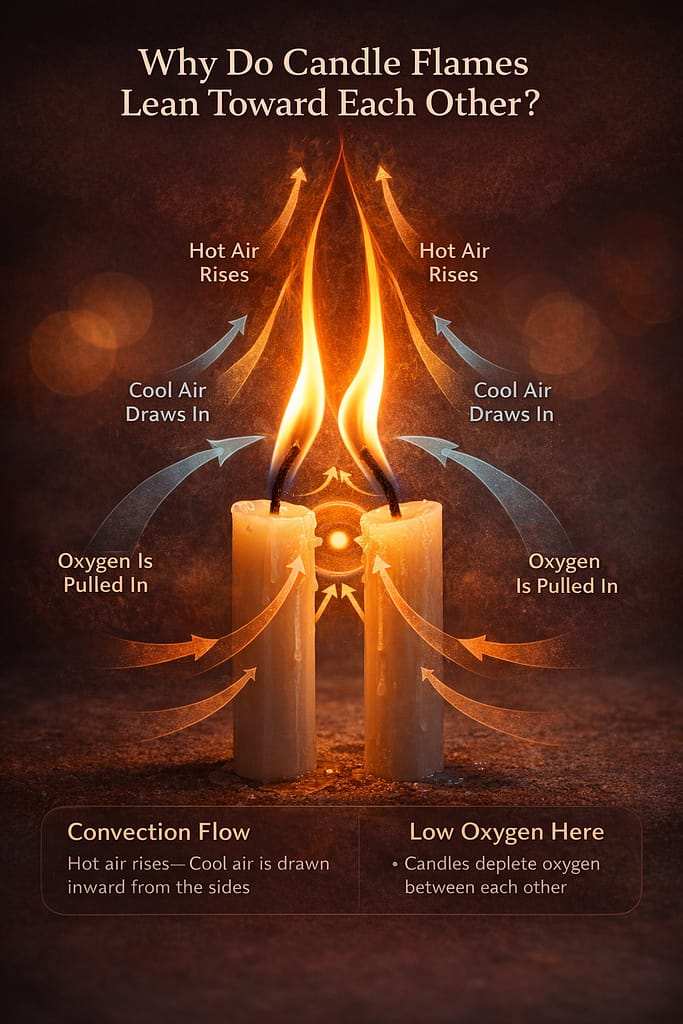
Why Do Candle Flames Lean Toward Each Other?
A short story of quiet science.
Two candles.
Lit side by side.
No wind. No hands.
Yet their flames — slowly, curiously — bent toward each other.
You watched.
And wondered.
Are they alive?
In love?
Are they… dancing?
It felt like magic.
But it wasn’t.
It was air. And heat. And a little thing called convection.
Here’s what’s happening:
Each flame heats the air around it. That hot air rises — fast — pulling cooler air in from below and around the sides.
When two flames are close, the air between them gets caught in a tug-of-war.
Both flames pull oxygen-rich air toward themselves.
But in the middle — right between them — the air is warmer, lighter, and has less oxygen.
So the flames, without even knowing it, lean in.
Drawn to where the other’s pull is stronger.
They bend toward balance.
Toward shared breath.
Sometimes, their flickers even sync up, like they’re swaying in rhythm — not just visually, but physically. That’s called oscillation coupling.
It happens in fire.
It happens in hearts.
It happens in stars.
So no — they’re not in love.
They’re following the rules of physics.
But somehow…
That makes it feel even more special.