
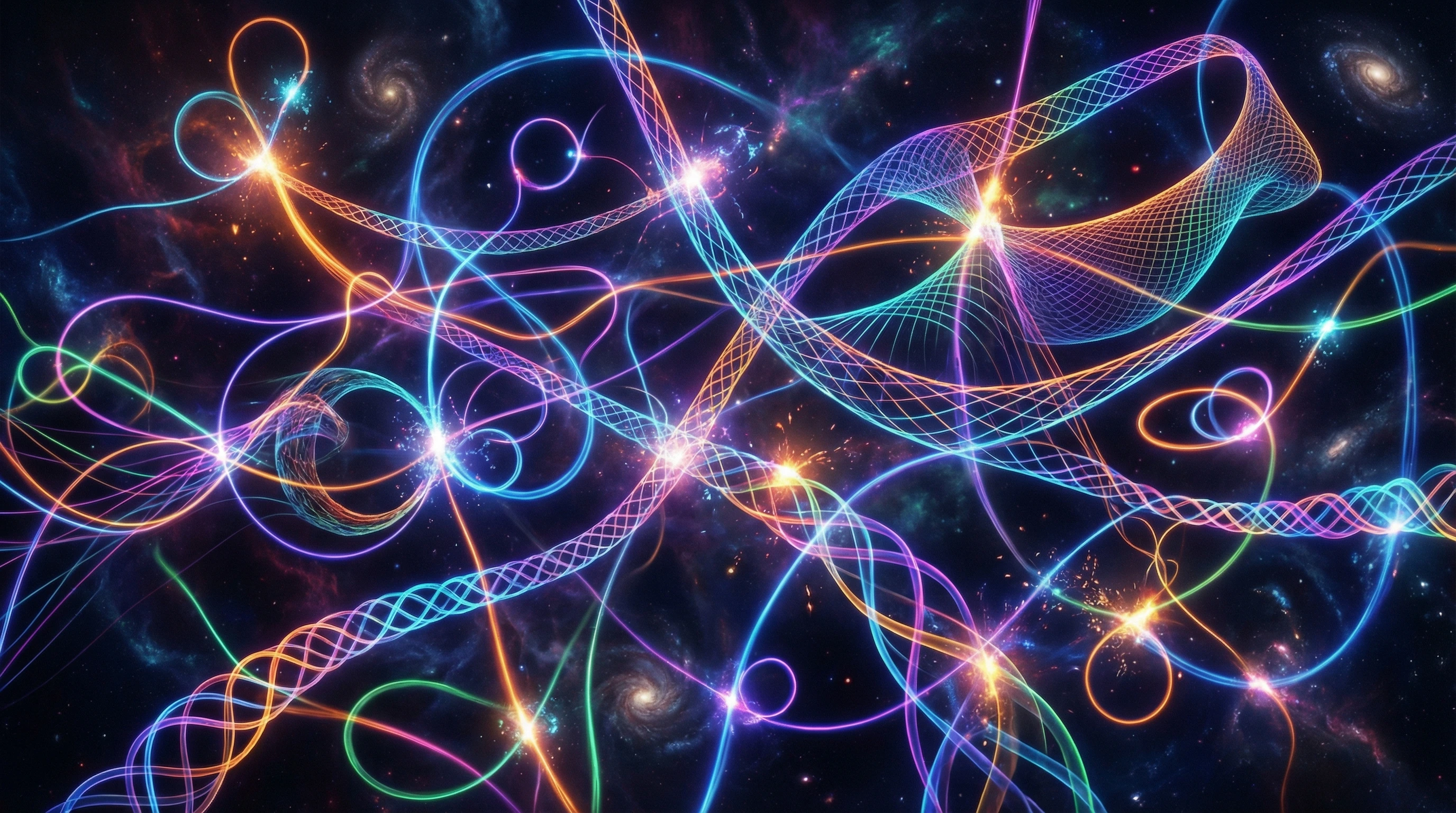
String Theory Explained or The Quest For The Theory Of Everything
String theory is one of the most talked-about ideas in physics right now. For decades, scientists like me have been trying to find one explanation that connects all the forces in the universe. Gravity, electromagnetism, and the nuclear forces all feel different, but the real buzz in science is figuring out the “Theory of Everything”—something that ties all these pieces together. String theory steps in as a possible answer and has fascinated both experts and fans for years. If you’ve ever wondered what string theory is about and why it matters, I’m going to break it down in a way that’s easy to follow. Time to roll into the details and check out why this theory matters.
What String Theory Tries to Solve
The big goal of string theory is to explain how every force and particle works together in a single, all-in-one framework. Right now, there are two major sets of rules in physics. One is general relativity, which explains gravity and things as big as galaxies. The other is quantum mechanics, covering the bizarre rules that apply to objects smaller than atoms. But here’s the rub—these theories don’t mix well. Gravity doesn’t play nicely at tiny scales, while quantum rules don’t handle massive objects smoothly.
Over the years, physicists have bumped into this clash while exploring black holes or what happened right after the Big Bang. For example, general relativity can describe how stars curve the space around them, but it doesn’t handle the behavior of particles inside an atom. String theory aims to fill this gap by providing one set of rules that works at all sizes. This is a huge motivation for many researchers, since solving the disconnect could unlock answers to some of the universe’s biggest mysteries.
How String Theory Describes the Universe
At the heart of string theory is a simple but mind-bending idea: instead of treating particles like tiny balls, it says everything is made of supersmall, vibrating strings. If you look close enough—way beyond what any microscope can see—what you’d find isn’t a dot, but a tiny loop or strand. These strings can wiggle in different ways, and their vibrations create everything we see in nature.
This is similar to how different notes come from the same guitar string, just by vibrating at different speeds. In string theory, a string vibrating one way acts like a photon (the particle of light). Vibrating another way, it acts like an electron or even the force-carrying particle for gravity, called the graviton.
Core Ideas and Vocabulary in String Theory
- Strings: These are the most basic pieces, acting kind of like rubber bands on a much, much smaller scale. Strings can be open (with two ends) or closed loops.
- Extra Dimensions: String theory needs more than the three dimensions of space and one of time that I experience. In most versions, there are 10 or even 11 total dimensions, but most are rolled up so small I never notice them.
- Branes: These are higher-dimensional objects that strings can attach to or move around on. The universe could actually be “on” a brane, with strings stretched along it.
- Supersymmetry: According to string theory, every particle should have a partner with different properties. This idea helps the math work out, but we haven’t seen these partner particles yet in experiments.
Another key term is “compactification”—the way those extra dimensions are folded up so tightly that we don’t notice them. This topic is still the subject of much research, with physicists developing clever ways to picture these curled up spaces.
String Theory’s Five Main Versions
When physicists first worked on string theory, they came up with several different types—five in total. Each version had different kinds of strings and rules. For a while, this seemed confusing and messy. However, a breakthrough in the 1990s called the “Second Superstring Revolution” showed all these versions are really just different views of one bigger theory, sometimes called “M-theory.” It’s almost like realizing different recipes are just variations of the same dish, with small tweaks making big differences in flavor.
M-theory itself is still mysterious, but it’s helped physicists connect the dots among these five original branches. By using tools known as dualities, scientists can show how one version of the theory “morphs” into another, depending on the scale or energy you look at.
How String Theory Has Impacted Physics
Even though string theory has not yet been proven by experiments, it’s already changed how physicists think about things. The math behind string theory has led to new ideas in black hole physics, quantum computing, and even pure mathematics. For example, string theory showed surprising connections between gravity in one kind of space and quantum forces in another. (This is known as the AdS/CFT correspondence for those who want to jump into deeper waters.)
Some practical benefits, like better understanding the entropy of black holes, came directly from string theory, even if we haven’t spotted strings themselves. The frameworks and math invented by string theorists have made it easier to tackle questions nobody else could solve with previous tools.
Common Questions or Objections About String Theory
- Why haven’t we seen strings in experiments? Strings are so incredibly tiny, smaller than anything we can measure with today’s technology. To test string theory directly, we’d need powerful machines much beyond what’s possible at present.
- Is string theory even testable? Some critics say that since string theory hasn’t led to specific predictions I can double-check, it’s more math than science. Still, researchers are looking for indirect ways to test it, such as searching for evidence of extra dimensions at particle colliders or looking for cosmic signatures left over from the early universe.
- Why do we need extra dimensions? The equations in string theory only make sense if there are more than four dimensions. The extra ones are hidden or “compactified” so I can’t see or experience them directly, but they influence the properties of particles.
Another point that comes up a lot is about supersymmetry. If nature really does have partner particles for all we see, why hasn’t the Large Hadron Collider found them yet? This continues to be a major puzzle, and many are waiting for more data from upcoming experiments to shed light on it.
Challenges String Theory Faces
- Lack of Direct Evidence: Because the scales involved are so tiny and so energetic, I have no way to directly detect strings using current technology. Most supporting evidence is from math, not measurements.
- Complex Math: The calculations can get really complicated, and it’s easy for even experienced researchers to get lost in the details. This keeps some of the most exciting questions difficult to tackle.
- Tied to New Particles: For string theory to work, new particles predicted by supersymmetry should exist. Despite looking, I haven’t seen clear evidence of these particles in collider experiments like those at CERN’s Large Hadron Collider.
- Multiple Solutions: String theory predicts many possible universes—a situation sometimes called the “landscape problem.” This makes it tricky to know which (if any) matches my own universe.
Lack of Direct Evidence
One of the biggest hurdles is that strings are insanely tiny—about a billion billion times smaller than a proton. This means even our most powerful machines can’t “see” them directly. Most current support comes from how string theory makes other hard problems easier to handle, or the way it brings gravity into the quantum world at all. For now, scientists are looking at creative ways to get indirect hints, such as potential echoes in cosmic background radiation or gravitational waves.
Mathematical Challenges
String theory’s math is intense. Sometimes, I find myself wading through pages of equations just to answer a small part of a problem. This complexity makes it exciting but also really hard for new scientists to jump in quickly. It also means that breakthroughs often take years or even decades of piecing together small clues from complicated calculations.
Advanced Insights from String Theory
Despite the challenges, string theory has inspired fresh ways of thinking, even outside physics. For instance, it’s helped mathematicians solve geometry and topology problems that once looked unsolvable. In quantum computing, insights from string theory about information flow are already influencing new research. Some believe that even if string theory itself needs tweaking or replacing, its ideas will have a lasting impact for years to come.
Researchers continue to look for new clues that could point the way forward. For instance, scientists hope that future space missions will uncover signatures from extra dimensions in cosmic background radiation, or that the next generation of colliders will catch hints of superpartners. As technology improves, possible new tests might not be all that far off—and any evidence, even if indirect, could guide the next stage of research.
Practical Context: Where String Theory Pops Up
It might surprise you, but string theory’s reach isn’t limited to pure physics labs. Here are a few ways I see its influence:
- Mathematics: The math behind string theory has helped solve puzzles in geometry and topology that once looked unsolvable.
- Quantum Gravity: It gives a possible route for finally explaining what happens inside black holes, or what happened at the birth of the universe.
- Cosmology: Some scientists think string theory could eventually explain dark matter, dark energy, or the shape of the cosmos.
Beyond these, string theory’s concepts sometimes even pop up in unexpected fields, like condensed matter physics, where theorists use similar math to look at exotic states of matter.
Frequently Asked Questions
Question: What would it mean if string theory is correct?
Answer: It would mean that everything in the universe—matter, forces, space, and time—comes from the same basic building blocks and laws. I’d finally have a single explanation for all physical phenomena, giving a satisfying sense of unity to the cosmos.
Question: Are there other theories competing with string theory?
Answer: Yes. Loop quantum gravity and a few other approaches try to cover similar territory. Right now, string theory is the most developed, but the search is wide open. Each theory offers its own take, and debates about which is best often spark new ideas on both sides.
Question: Why do some physicists disagree about string theory?
Answer: Some experts want a theory that offers predictions we can double-check directly. Until then, debates are likely to continue, which is totally normal for big scientific ideas. Others argue the theory should be valued for the math and connections it’s uncovered, even if physical proof is slow in coming.
Why String Theory Still Matters
Even though string theory hasn’t answered every question yet, it keeps attracting new researchers and giving students plenty to study. Its biggest draw is the dream of finding one clear answer to how the universe works. Even if string theory changes or new discoveries mix up the details, the need for a “Theory of Everything” remains strong. The adventure of discovery in physics is ongoing, and string theory is still in the running. There’s a real sense that the next eye-catching breakthrough could be just over the horizon, making this one of the most exciting rides in science today.