
🧬 Proteins in the Brain–Body Puzzle
1. Structural & Functional Role
- Proteins form the scaffolding of neurons, synapses, and receptors.
- They also act as enzymes, hormones, and transporters — basically, the workers of the cellular city.
2. Proteins in Alzheimer’s
- Amyloid-beta: A misfolded protein fragment that clumps into plaques, disrupting communication between neurons.
- Tau protein: Normally stabilizes microtubules inside neurons; in Alzheimer’s, it tangles up and causes transport chaos.
- Both are examples of how protein mismanagement leads to neurodegeneration.
3. Proteins in Fibromyalgia
- Not about plaques or tangles, but there’s evidence of altered cytokine proteins (immune messengers).
- Some patients show elevated inflammatory proteins, hinting that fibro is more about protein signaling gone wrongthan structural collapse.
4. Dietary Proteins
- Quality matters: animal vs. plant proteins differ in amino acid profiles.
- High-protein diets (esp. leucine, tryptophan) can influence neurotransmitter balance (serotonin, dopamine).
- Processed proteins (hydrolyzed, artificial isolates) may carry additives or altered structures that confuse the gut–immune axis.
5. Proteins + APOE4
- APOE itself is a protein (apolipoprotein E), crucial for lipid transport and neuronal repair.
- The ε4 variant produces a form of the protein that is less efficient at repair, and more prone to pro-inflammatory cascades.
- So proteins aren’t just dietary fuel — they’re directly coded into the risk machinery.
⚖️ The Big Protein Question
Could dietary protein quality interact with genetic protein vulnerabilities (like APOE4) to influence cognitive decline or fibromyalgia symptoms?
For example:
- Poor protein intake → fewer amino acids for neurotransmitters → mood/fog issues.
- Excess processed protein → gut inflammation → more cytokine noise.
- APOE4 protein inefficiency → compounding the above.
Proteins are Builders and Breakers of Brains
Proteins usually get billed as the heroes of nutrition. Fitness magazines praise them for building biceps, diet gurus count their grams, and doctors remind us they’re essential to health. But in the world of Alzheimer’s, fibromyalgia, and brain fog, proteins play a more complicated role. Sometimes they build. Sometimes they break. And sometimes, they just confuse everyone.
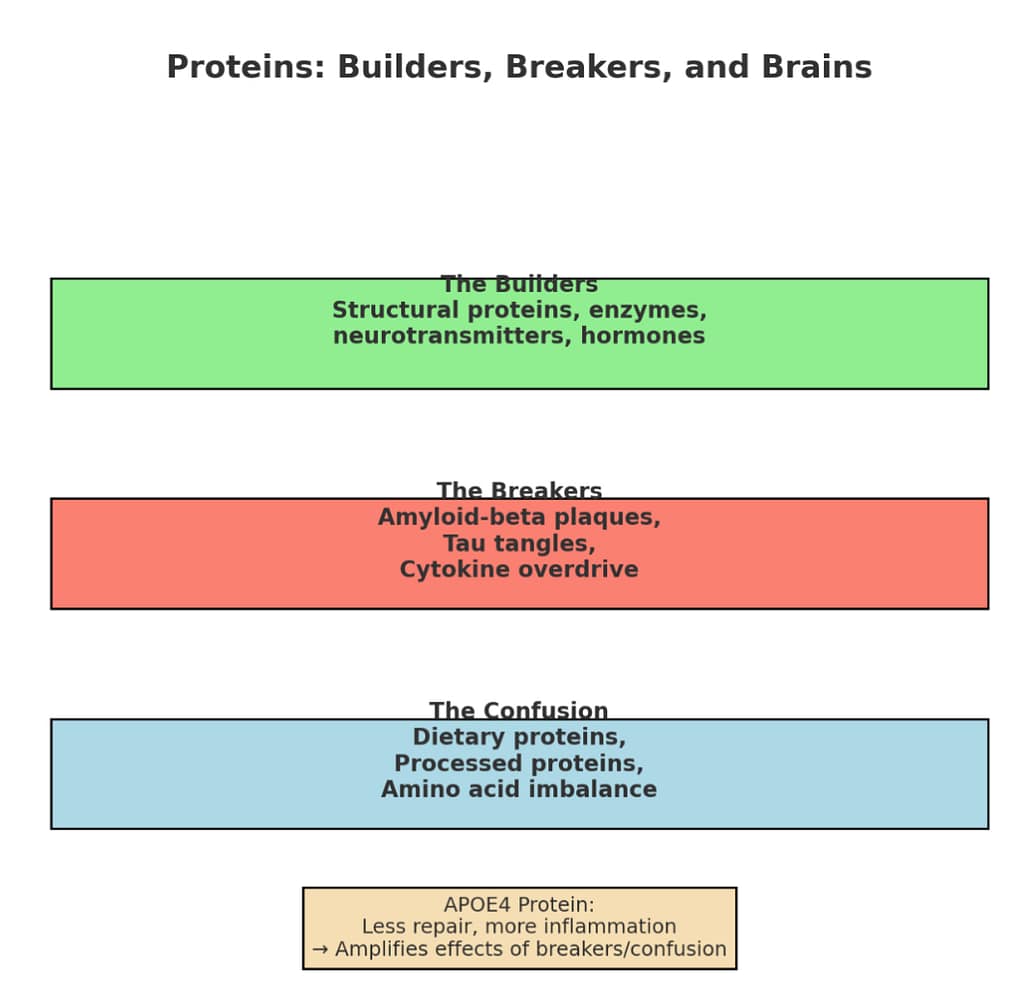
The Builders
Proteins are the ultimate multitaskers. They:
- Build structures: neurons, receptors, enzymes
- Carry messages: hormones and neurotransmitters
- Repair damage: rebuilding tissue after stress
Without proteins, your body would be like a construction site with no workers.
The Breakers
But when proteins misbehave, things get messy:
- Amyloid-beta: a protein fragment that clumps into plaques in Alzheimer’s brains (Hardy & Selkoe, 2002).
- Tau protein: normally stabilizes neurons’ inner scaffolding; in Alzheimer’s it tangles, strangling communication (Bloom, 2014).
- Cytokines: small signaling proteins; in fibromyalgia, elevated cytokines may act like a broken intercom system, amplifying pain and fatigue (Bazzichi et al., 2007).
When proteins fold wrong or signal too loudly, they turn from builders into breakers.
The Confusion in Diet and Daily Life
Not all protein is created equal.
- Animal vs. plant proteins differ in amino acid makeup.
- Processed proteins (hydrolyzed, isolated) may come with additives or altered structures that confuse the gut and immune system.
- Amino acids like tryptophan and tyrosine are precursors for serotonin and dopamine. Too little—or too much—can shift mood, energy, and clarity.
APOE is The Protein That Tips the Scale
Apolipoprotein E (APOE) is itself a protein. It helps shuttle fats around the brain and repair neurons. But the APOE4 variant makes a less efficient version—slower at repair, quicker to inflammation. It’s like hiring a construction crew that argues more than it builds. And when combined with other protein disruptions (amyloid, tau, cytokines), the risk of cognitive decline deepens.
The Big Protein Question
So here’s the puzzle:
- Could poor-quality protein diets amplify fibromyalgia symptoms or cognitive fog?
- Could excess processed proteins stress the gut–immune axis, worsening inflammation in APOE4 carriers?
- Could targeted protein nutrition—balanced amino acids, anti-inflammatory peptides—protect vulnerable brains?
Final Thought
Proteins aren’t just gym fuel. They are the language of life, and sometimes, its miscommunication. For Alzheimer’s patients, fibromyalgia warriors, and anyone navigating brain fog, proteins may be both the message and the mystery.
In the end, proteins remind us of a simple truth: what builds us up can also break us down. The art is in balance.
Make your own inventive corner
Ready to start your own website and share your passion with the world? Join me and unlock step-by-step training to build your online presence just like I did! Use my links if you want me as your coach!