
History And Mathematics Behind Mysterious Magic Squares
Magic squares are one of those fascinating mathematical wonders that have caught the interest of mathematicians and enthusiasts alike throughout history. A magic square is a grid of numbers arranged so that the sum of every row, column, and diagonal is the same. Sounds simple, right? But don’t be fooled; the beauty of magic squares lies in their simplicity and the hidden complexities within.
Travel back in time, and you’ll find magic squares scattered across the pages of history from as early as ancient China to the mathematical traditions of India, Egypt, and beyond. These enigmatic patterns were more than just puzzles; they were revered and even infused with mystical and cultural significance.
Today, these patterns continue to intrigue people, blending the staid logic of mathematics with a touch of mystery that keeps even seasoned mathematicians on their toes. As we explore the allure of magic squares, we unravel what makes them a timeless enigma that’s captured the imaginations of people across civilizations.
The Ancient Origins and Cultural Significance of Magic Squares
Magic squares have roots that stretch deep into the ancient world, making their way out of early civilizations where they first took on the mantle of mystery and wonder. Among the most notable is the Lo Shu Square, thought to be the earliest recorded magic square, originating from China. Legend has it that this pattern was discovered on the back of a turtle emerging from the Yellow River, capturing the imagination of scholars and becoming a foundational element in Chinese numerology and cosmology.
In India, magic squares found their place etched into temple walls and sacred texts, woven into the spiritual tapestry as yantras—geometric configurations considered powerful tools in ritualistic and meditative practices. Here, they signified the cosmic balance, linking the earthly realm with the divine.
Magic squares also found their place in the Islamic world, prominently featured in art and architecture. These mathematical wonders symbolized complexity and balance, reflecting the pursuit of knowledge that was central to Islamic culture during the Golden Age. Their presence in these contexts elevated magic squares from mere puzzles to symbols of divine perfection and intellectual inquiry.
Beyond mathematics, magic squares were seen as talismans in various cultures. People believed these squares held protective powers, offering blessings or warding off evil when used in the right configurations. From engravings and textiles to talismans, magic squares have made their mark as more than numbers placed in strategic spots; they speak to ancient beliefs about the universe’s harmony.
These ancient roots highlight the universal allure of magic squares, transcending their numerical nature to become cultural icons and symbols of human curiosity and creativity. Understanding their ancient origins enriches our appreciation of their place in history and how these timeless patterns influenced traditions worldwide.
The Mathematics Behind the Magic and the Logic of Magic Squares
At first glance, magic squares might seem like mere number puzzles, but there’s a rich vein of mathematical principles lying underneath their deceptively simple surfaces. At their core, magic squares involve arranging numbers in a grid so that the sum of numbers in each row, column, and diagonal is identical, known as the magic constant.
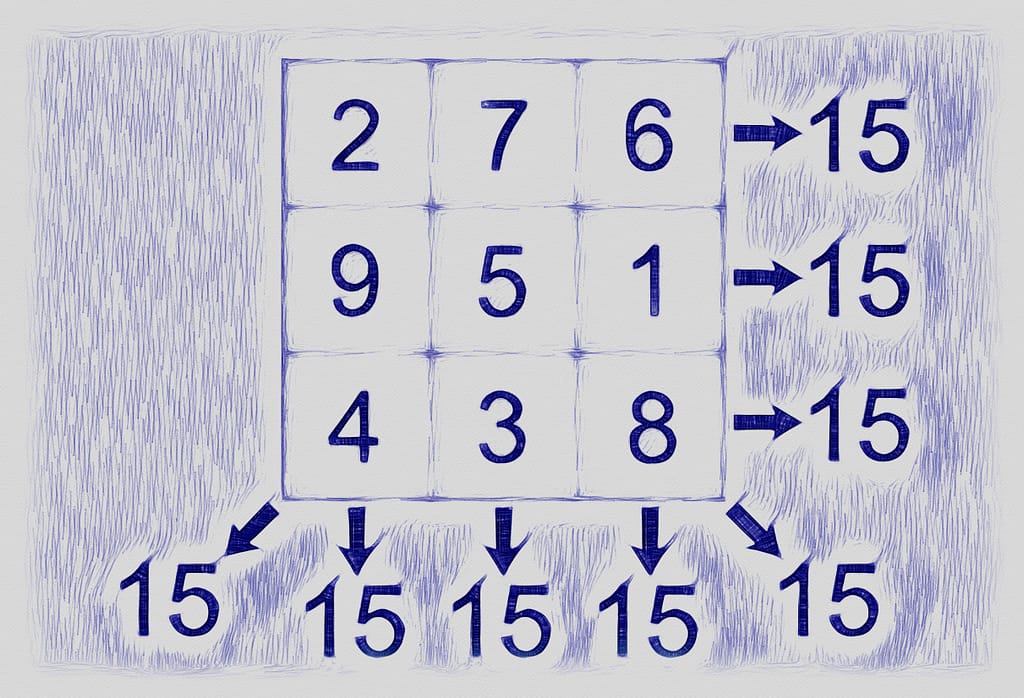
One interesting aspect is how you create these squares. For a standard 3×3 magic square using numbers 1 to 9, every row, column, and diagonal adds up to 15. The formula to calculate the magic constant for an n x n square using consecutive numbers is often intriguing for first-timers: n(n² + 1)/2.
Different types and variations keep mathematicians busy. Besides the well-known 3×3 version, there are 4×4 orders and larger, each posing unique challenges and requiring diverse strategies to arrive at the solution. Larger squares often introduce different techniques, using arithmetic progression or modular arithmetic to lay out the numbers properly.
The versatility of magic squares also ties into fascinating applications in mathematical theory and throughout history. Besides recreational puzzles that provide a fun dive into logic and numbers, magic squares have shown up in cryptography as encryption matrices, highlighting their relevance in modern computational concepts.
Understanding how these squares work not only satisfies curiosity but also improves problem-solving skills, as they push you to think critically about numbers, arrangement, and symmetry. Whether you’re a casual puzzle enthusiast or a math aficionado, there’s plenty to explore and appreciate within the logic and order of these age-old enigma.
Famous Magic Squares Through History
Magic squares have left their mark across various epochs, intriguing great minds and gathering fame along the way. Among the most celebrated is the Lo Shu Square, a 3×3 magic grid that stands as one of the earliest known examples, deeply intertwined with Chinese numerology and philosophy.
Another noteworthy example is the magic square crafted by Albrecht Dürer, an emblem of mathematical finesse and artistry. Dürer’s Melencolia I engraving features a sophisticated 4×4 magic square, where not only do the sums align to 34, but the squares also contain his artwork’s year (1514) in the bottom row, adding historical subtlety and allure.
These squares were also popular in India during the reign of Emperor Akbar. His fascination with them led to the creation of intricate patterns and magic squares of unusual orders, showcasing the playful and intellectual indulgence of mathematical exploration in the Mughal courts.
The Renaissance period in Europe saw a surge in the interest in magic squares, featuring prominently in various scholarly and esoteric texts. Sheikh mathematician Moschopulus is credited with rekindling curiosity around these patterns, presenting methods to construct larger magic squares that surpassed earlier limits.
Each of these famous squares comes with its set of fun anecdotes, often wrapped in myth and legend. Whether it’s Dürer embedding his mark in his art or mystic stories from dynastic China, magic squares have inspired narratives that intertwine real and imagined histories, adding to their storied legacy.
Exploring these historical examples not only showcases the timeless intrigue of magic squares but also highlights the creative and mathematical prowess of our ancestors, serving as reminders of the bridge between art, numerology, and empirical logic.
Magic Squares in Contemporary Society and Their Modern Applications
Magic squares aren’t just relics of the past; they continue to find relevance and application in today’s world in numerous surprising ways. In recreational mathematics, they offer a delightful challenge, sparking curiosity and encouraging logical thinking. Whether in educational settings or puzzle books, magic squares make numbers approachable and fun.
In modern art and design, they serve as inspiration due to their inherent symmetry and balance. Artists and designers adopt these grids, transforming numerical sequences into visual masterpieces that captivate the viewer’s eye with structured beauty. Magic squares have influenced pattern designs, architecture, and even graphic illustrations, underscoring their aesthetic versatility.
The realm of cryptography and coding also sees the practical use of magic squares. Due to their ordered nature, these grids can act as encryption templates in which information can be masked and unmasked systematically. They help in the design of algorithms and complex coding systems, where structure and unpredictability must coexist.
Magic squares have educationally beneficial roles, too, helping students grasp complex concepts through tangible examples. They offer a hands-on approach to learning sequences, adding, and problem-solving, making them a valuable tool in developing mathematical intuition.
While their ancient allure persists, magic squares hold promising potential for future exploration and innovation. They keep mathematicians curious, offering endless possibilities for discovery within their bounded grids, thus continuing their legacy as both a mathematical marvel and a cultural icon.
Craft Your Own Magic Square with a Step-by-Step Guide
Anyone can enjoy the process of creating a magic square, whether you’re a math enthusiast or just someone looking to explore something new. Starting with a basic 3×3 magic square is a good way to dip your toes into these intriguing patterns.
To craft a simple 3×3 magic square, it’s important to first understand the layout. Number the grid from 1 to 9 in such a way that each row, column, and diagonal adds up to 15. A great starting position is putting the number 1 in the middle of the first row. Then, proceed to place the remaining numbers following a ‘move up and right’ method. If you move outside the grid, wrap around to the opposite side.
For those eager for a challenge, constructing larger magic squares, like the 4×4 or 5×5, might be tempting. These squares require different techniques, such as the Lo Shu method or even using computer algorithms to find and verify your solutions.
Using resources like graph paper or drawing tools can help maintain neatness and clarity as you create. There’s a satisfaction in getting the numbers correct and knowing that you’ve recreated something with such historical and cultural weight.
In crafting your magic square, you’re not just playing with numbers. You’re engaging with a piece of mathematical history and a puzzle that’s intrigued minds for centuries. So grab a pencil, set up your grid, and experience the magic for yourself.
Have fun!
Shop Tip
Make your own inventive corner
Ready to start your own website and share your passion with the world? Join me and unlock step-by-step training to build your online presence just like I did! Use my links if you want me as your coach!