The Fields Medal
The Fields Medal – Nobel Prize of Mathematics
The Fields Medal, often referred to as the “Nobel Prize of Mathematics,” is one of the most prestigious awards in the field. Established in 1936, the medal is awarded every four years to up to four mathematicians under the age of 40 who have made significant contributions to mathematics. The award recognizes both outstanding achievements and the promise of future work in the field. Named after the Canadian mathematician John Charles Fields, the medal aims to honor groundbreaking work and inspire further research and development in mathematics.
Origins and Purpose
John Charles Fields was a Canadian mathematician and a professor at the University of Toronto. He played a pivotal role in organizing the International Congress of Mathematicians (ICM) in Toronto in 1924. Recognizing the need to inspire and reward young mathematicians, Fields proposed the establishment of an international medal for mathematical achievement. The first Fields Medals were awarded at the 1936 ICM in Oslo, Norway, to Lars Ahlfors and Jesse Douglas.
The Fields Medal is awarded by the International Mathematical Union (IMU), and the selection process is rigorous and highly secretive. The award committee considers nominations from mathematicians worldwide, evaluating the nominees’ contributions to the field and their potential for future discoveries.
Contributions of the Fields Medal
The Fields Medal has been instrumental in highlighting and promoting significant mathematical discoveries. It has brought recognition to diverse areas of mathematics, from pure to applied, and has encouraged collaboration across disciplines. The award has also helped elevate the status of mathematics in the global scientific community and has inspired young mathematicians to pursue ambitious research projects.
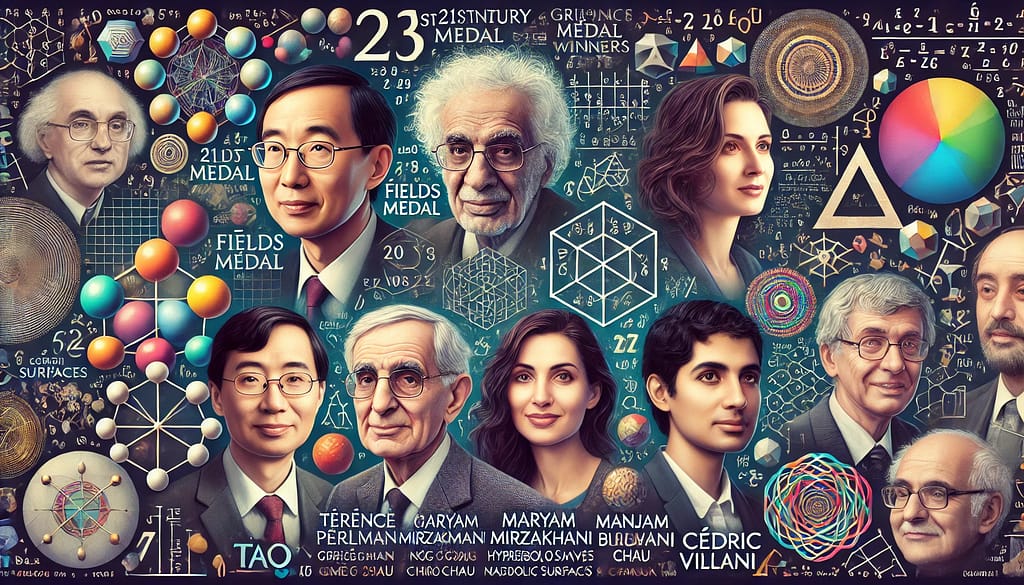
Notable Fields Medal Winners of the 21st Century
Terence Tao (2006)
Terence Tao is widely regarded as one of the most brilliant mathematicians of his generation. Born in Australia in 1975, Tao showed extraordinary mathematical talent from a young age. He received the Fields Medal in 2006 for his contributions to partial differential equations, combinatorics, harmonic analysis, and additive number theory.
One of his most famous results is the Green-Tao theorem, co-authored with Ben Green, which states that there are arbitrarily long arithmetic progressions of prime numbers. This groundbreaking work has profound implications for number theory and has opened up new avenues of research.
Grigori Perelman (2006)
Grigori Perelman, a reclusive Russian mathematician, gained international fame for solving the Poincaré Conjecture, one of the seven Millennium Prize Problems posed by the Clay Mathematics Institute. The conjecture, formulated by Henri Poincaré in 1904, is a fundamental problem in topology, dealing with the characterization of three-dimensional spheres.
Perelman’s proof, published in a series of papers in the early 2000s, utilized Richard S. Hamilton’s theory of Ricci flow and introduced novel techniques. Despite being awarded the Fields Medal in 2006, Perelman declined the honor, citing ethical concerns about the mathematics community.
Maryam Mirzakhani (2014)
Maryam Mirzakhani, an Iranian mathematician, made history as the first woman to receive the Fields Medal. Born in 1977, Mirzakhani completed her Ph.D. at Harvard University under the supervision of Curtis McMullen. She was recognized in 2014 for her work on the dynamics and geometry of Riemann surfaces and their moduli spaces.
Mirzakhani’s research provided deep insights into the behavior of geodesics on hyperbolic surfaces and the geometry of moduli spaces. Her work has had a significant impact on several areas of mathematics, including ergodic theory, hyperbolic geometry, and Teichmüller theory. Tragically, Mirzakhani passed away in 2017, but her legacy continues to inspire mathematicians worldwide.
Ngô Bảo Châu (2010)
Ngô Bảo Châu, a Vietnamese mathematician, received the Fields Medal in 2010 for his proof of the Fundamental Lemma in the theory of automorphic forms. Born in 1972, Ngô completed his Ph.D. at the Université Paris-Sud under the supervision of Gérard Laumon.
The Fundamental Lemma, a conjecture proposed by Robert Langlands and Diana Shelstad, is a key component of the Langlands program, which seeks to connect number theory and representation theory. Ngô’s proof, achieved using sophisticated algebro-geometric techniques, has profound implications for the field and has advanced our understanding of automorphic forms.
Manjul Bhargava (2014)
Manjul Bhargava, an Indian-American mathematician, was awarded the Fields Medal in 2014 for his contributions to number theory. Born in 1974, Bhargava completed his Ph.D. at Princeton University under the supervision of Andrew Wiles.
Bhargava’s work has revolutionized the geometry of numbers, a field concerned with the distribution of algebraic objects. He developed novel methods for counting rings of small rank and provided new insights into the average rank of elliptic curves. His research has broad applications, from cryptography to the theory of quadratic forms.
Cédric Villani (2010)
Cédric Villani, a French mathematician, received the Fields Medal in 2010 for his work on Landau damping and the Boltzmann equation. Born in 1973, Villani completed his Ph.D. at the Paris Dauphine University under the supervision of Pierre-Louis Lions.
Villani’s research has focused on the mathematical foundations of kinetic theory, which describes the behavior of gases and plasmas. His contributions to optimal transport theory have also had significant applications in economics, physics, and geometry. Villani is known for his ability to communicate complex mathematical ideas to a broader audience and has authored several popular science books.
Conclusion
The Fields Medal continues to be a beacon of excellence in mathematics, recognizing and celebrating the achievements of the world’s brightest mathematical minds. The contributions of its winners have not only advanced our understanding of mathematics but have also inspired new generations of mathematicians to explore and innovate. As the 21st century progresses, the Fields Medal will undoubtedly continue to play a crucial role in shaping the future of mathematics and fostering a deeper appreciation for the beauty and power of mathematical thought.
Shop Tips
Make your own inventive corner
Ready to start your own website and share your passion with the world? Join me and unlock step-by-step training to build your online presence just like I did! Use my links if you want me as your coach!