
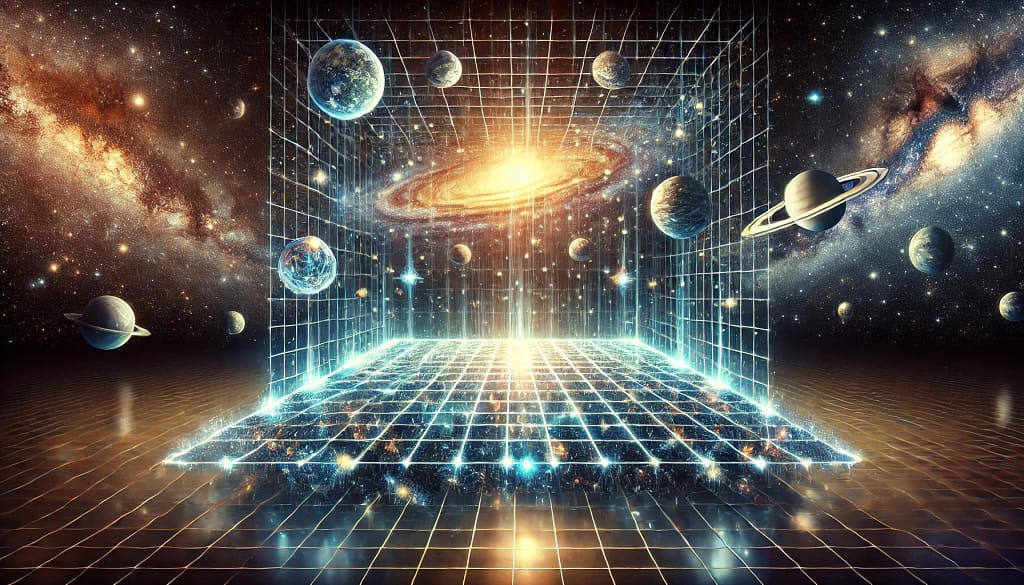
Reality as a Projection
The idea that our universe might be a holographic projection, rather than a solid, objective reality, has emerged as a provocative theory within quantum physics. This concept, deeply explored in Stephen Davis’s workshop series “The Holographic Universe,” suggests that what we perceive as our physical reality is actually a sophisticated illusion. This idea finds roots in the works of physicists like David Bohm and Karl Pribram, and has been popularized by Michael Talbot’s book, “The Holographic Universe.”
The Holographic Universe Theory
The holographic universe theory posits that the entire universe can be seen as a two-dimensional information structure “painted” on the cosmological horizon, such that the three dimensions we observe are an effective description at macroscopic scales and low energies. This theory gained traction following a 2012 experiment by German scientists using the GEO 600 gravitational wave detector, which provided evidence suggesting that space-time might have a granular structure at microscopic scales, much like a holographic image.
Proponents argue that just as a hologram—a three-dimensional image created from a two-dimensional surface—produces a complete picture, our universe could similarly be a projection from information encoded on a distant, lower-dimensional surface.
Defenders of the Holographic Universe
- David Bohm: Bohm, a renowned quantum physicist, developed the concept of the “implicate order,” suggesting that the universe’s underlying reality is an undivided whole, with everything interconnected in a deeper, more fundamental order. This ties closely with the holographic principle, proposing that what we see as distinct objects are projections from a deeper level of reality.
- Karl Pribram: A neurophysiologist, Pribram proposed that our brains process information similarly to a hologram, converting wave frequencies into a coherent image of reality. Pribram’s research into memory storage suggested that memories are stored not in specific brain cells but in patterns of nerve impulses, akin to how holographic images are stored.
- Leonard Susskind: Susskind, a prominent theoretical physicist, has been a strong advocate for the holographic principle. He argues that black hole physics implies that the information contained within a three-dimensional volume can be encoded on a two-dimensional boundary, supporting the idea that our universe is a holographic projection.
- Brian Greene: Greene, a theoretical physicist, and author, explores the holographic universe in his work. In the “Fabric of the Cosmos” series, he discusses how space might be an illusion, emerging from a deeper, two-dimensional reality.
Objectors and Criticisms
- Lee Smolin: Smolin, a theoretical physicist, has critiqued the holographic principle for being speculative and lacking empirical evidence. He argues that while the theory is mathematically appealing, it does not provide testable predictions that can be verified through experiments.
- Roger Penrose: Penrose, a physicist and mathematician, has been skeptical of the holographic principle’s implications for consciousness and reality. He questions whether such abstract mathematical formulations can truly capture the complexities of the universe and consciousness.
- Sabine Hossenfelder: A physicist and author, Hossenfelder has voiced concerns about the holographic principle, suggesting that it might be an overextension of mathematical models without sufficient empirical backing. She emphasizes the need for concrete experimental evidence to support such radical claims about the nature of reality.
Evidence and Experiments
Several key experiments lend support to the holographic universe theory:
- Double-Slit Experiment: This classic experiment demonstrates that particles like electrons exhibit both wave-like and particle-like properties. When observed, they behave as particles, but when not observed, they produce an interference pattern characteristic of waves. This implies that the act of observation collapses their wave function into a specific state, suggesting that reality is influenced by observation.
- GEO 600 Gravitational Wave Detector: Researchers found unexpected noise in the detector that could be interpreted as evidence of a holographic structure to space-time. Craig Hogan, a physicist at Fermilab, proposed that this noise might be the result of the universe’s holographic nature.
- Quantum Eraser Experiments: These experiments show that information about which path a particle takes can be “erased,” resulting in the re-emergence of an interference pattern. This suggests that the reality we observe is not fixed until measured, aligning with the holographic principle.
Implications and Philosophical Considerations
The holographic universe theory challenges our fundamental understanding of reality. If true, it implies that our perception of a three-dimensional world is a construct, a projection from a deeper, more fundamental level of reality. This aligns with philosophical ideas from Eastern traditions, such as the concept of “Maya” in Hinduism, which describes the physical world as an illusion.
Moreover, the theory raises questions about the nature of consciousness and its role in creating reality. If our brains are holographic processors, then what we perceive as reality is a product of our neurological processes, influenced by wave frequencies from a deeper dimension.
Conclusion
The holographic universe theory remains a fascinating and controversial topic within physics and philosophy. While it offers a compelling explanation for certain quantum phenomena and aligns with some ancient philosophical views, it also faces significant challenges and skepticism from the scientific community. The debate continues as researchers strive to find more empirical evidence and develop a deeper understanding of the true nature of our reality.
For more
Visit www.holographicuniverseworkshops.com for more information about this workshop series.
Shop Tip
The Holographic Universe on Amazon
Make your own inventive corner
Ready to start your own website and share your passion with the world? Join me and unlock step-by-step training to build your online presence just like I did! Use my links if you want me as your coach!
See you there!